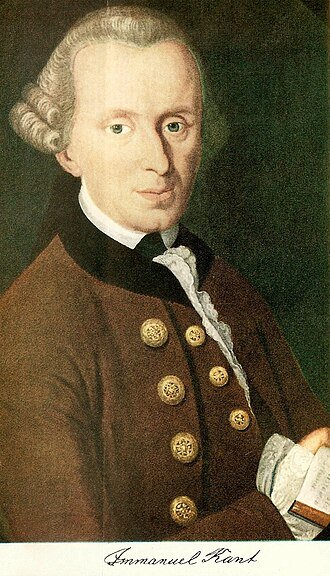
 AuthorImmanuel Kant1724–1804
Groundwork of the Metaphysics of Morals (Grundlegung zur Metaphysik der Sitten) was published by Immanuel Kant in 1785 and is the first of his mature works on moral philosophy. Together with the Critique of Practical Reason and The Metaphysics of Morals, it forms a trilogy on ethics that remains central to the field. Kant conceived it as a work of foundational ethics: its aim is to clear the ground for later research by clarifying the core concepts and principles of moral theory and showing that they are normative for rational agents. His ambition is to lay bare the fundamental principle of morality and to show that it applies to us.
The centre of the work is the categorical imperative, according to which one must act only according to maxims that one could will to become universal laws. Kant holds that the rightness of an action is determined by the principle on which a person chooses to act, not by its consequences or by moral feelings. This stands in sharp contrast to the moral sense theories and teleological theories that dominated moral philosophy in his time. For Kant, morality must rest on pure, a priori reason, independent of experience, because a genuinely binding moral law has to be universal and necessary.
The book consists of a preface and three sections. In the preface, Kant takes up the ancient Greek division of philosophy into logic, physics and ethics, distinguishes empirical from non-empirical parts of each discipline, and argues for a metaphysics of morals that can guard against confusion and rationalization in moral reasoning. The first section starts from common-sense morality and, through analysis of concepts such as the good, duty and moral worth, arrives at the supreme principle of morality. Here he introduces the good will as the only thing good without qualification, along with the well-known example of the honest shopkeeper who acts from prudence rather than duty. The second section develops the formulations of the categorical imperative, while the third, notoriously difficult, seeks to show that freedom is presupposed by the moral law and that this law binds us as rational beings.
Kant himself acknowledged the difficulty of the text, and some years later he expanded its arguments in the Critique of Practical Reason. Its influence has been immense: it has shaped contemporary ethical debate, the theory of autonomy, the concept of human dignity, and discussions of rights and justice. Critics have objected to its rigidity and its suspicion of emotion, yet it remains an indispensable reference for anyone seeking to understand the foundations of modern moral thought.
Themes
Other works by Immanuel Kant
Original Filopedia text based on Wikipedia (es) and Wikipedia (en) and Wikidata.