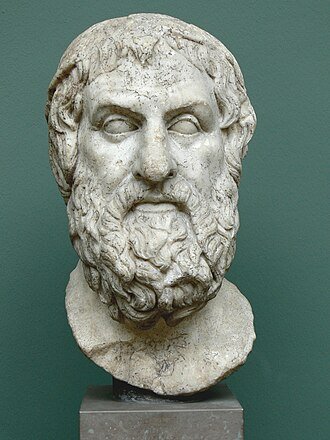
 AuthorSophocles495 BC–405 BC
Antigone is a tragedy by Sophocles, first performed in Athens, probably in 441 BC, although some sources place its premiere in 442 or 440 BC. It belongs to the so-called three Theban plays, together with Oedipus Rex and Oedipus at Colonus. Although the events it depicts come last in the chronology of the family of Oedipus, Sophocles wrote it first. It is considered one of the oldest surviving works by the author, and it draws on the Theban legend, picking up where Aeschylus' Seven Against Thebes ends.
The action takes place after the death of Oedipus, who had left Thebes in exile. His sons, Eteocles and Polynices, fought for the throne and died at each other's hands. Creon, Oedipus' brother-in-law and the new ruler of the city, decrees honours for Eteocles and a shameful punishment for Polynices, whose body must remain unburied on the battlefield, exposed to birds and scavenging animals. For the Greeks, denying burial was a grave offence that left the dead without rest.
Antigone, their sister, decides to bury Polynices regardless. Her sister Ismene, more fearful of authority, refuses to join her. When a sentry discovers that someone has covered the corpse with a little earth, Creon orders an investigation, and the culprit turns out to be Antigone, who confesses without denying anything. In her debate with the king, she argues that divine laws, unwritten and unchanging, stand above human decrees, and she remains unbending even in the face of death. Creon sentences her to be walled up alive in a cave.
The tragedy stages a conflict between two conceptions of duty: the family and religious bond defended by Antigone and the civic order embodied by Creon. Haemon, Creon's son and Antigone's fiancé, tries in vain to persuade his father, and the quarrel ends in a rupture. The blind seer Tiresias warns the king that the gods are angered and that his obstinacy will cost him a son. Creon finally relents, but too late: Antigone has hanged herself in the cave, Haemon kills himself beside her, and shortly afterwards his mother, Eurydice, also takes her own life. The king is left alone, aware that his pride has cost him everything.
The play has been read in many different ways across history. Hegel took it as an example of the clash between two equally legitimate rights, and in the twentieth century numerous authors and playwrights reinterpreted it as a symbol of resistance to tyranny. Its influence endures in Western theatre, philosophy and literature.
Themes
Other works by Sophocles
Original Filopedia text based on Wikipedia (es) and Wikipedia (en) and Wikidata.