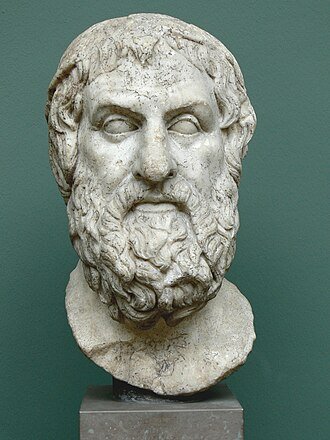
Sophocles
495 BC–405 BC · Athenian tragic playwright
Origins and family
Sophocles was born in Colonus, a village near Athens, into a well-off family. His father, Sophillus, is said to have been an armour manufacturer. The date of his birth is uncertain: the Parian Chronicle places it in 497 or 496 BC, while the anonymous author of his Life puts it in 495 BC. He received a thorough education, with teachers such as Lampros, who trained him in dance and the lyre. He was said to be physically handsome, though his voice was weak, and he enjoyed gymnastics, music and dance.
Youth and first triumphs
At the age of sixteen he led the chorus that sang a paean celebrating the Greek victory at Salamis in 480 BC. His first great success came in 468 BC, when he defeated Aeschylus, the reigning master of Athenian drama, at the Great Dionysia. According to Plutarch, the judges were not chosen by lot; the archon asked Cimon and the other generals present to decide the winner. Plutarch adds that Aeschylus then left for Sicily, although this detail is disputed.
Family life
Around 460 BC he married Nicostrate, with whom he had a son, Iophon, who also wrote tragedies. At around fifty he formed a relationship with Theoris of Sicyon, from whom came Ariston, father of a younger Sophocles who was also a playwright. The Suda names three other sons about whom little is known.
Public life
Sophocles took part in the civic life of Athens. Around 443-442 BC he served as one of the Hellenotamiai, the treasurers who administered the finances of the Delian League, and soon afterwards he was elected general, probably thanks to the success of Antigone. He served under Pericles in the Samian War, although the fleet he commanded was defeated by Melissus. According to his biographer he was not especially distinguished as a politician, but he loved his city and turned down invitations from foreign rulers rather than leave it. In 411 BC he sat on the board of commissioners set up after the disaster of the Sicilian expedition. He is also credited with receiving the cult of Asclepius into his house in 420 BC, which earned him the posthumous epithet Dexion, "the receiver"; some doubt attaches to the story.
Works and innovations
Ancient sources credit him with between 123 and 130 tragedies, but only seven survive complete: Ajax, Antigone, The Women of Trachis, Oedipus Rex, Electra, Philoctetes and Oedipus at Colonus. He competed in thirty contests and won eighteen at the Dionysia and six at the Lenaea. He is credited with introducing a third actor, which reduced the role of the chorus and opened new possibilities for conflict, and with increasing the chorus from twelve to fifteen members. He also wrote a treatise on the chorus, now lost. His characters are more fully developed than those of earlier playwrights, and his drama centres on the suffering of the hero, who endures alone and learns through pain.
Themes and irony
Three of his best-known plays, Oedipus Rex, Oedipus at Colonus and Antigone, are grouped as the Theban plays, although they were not written as a trilogy nor performed together. In them the protagonist seeks the truth and discovers, often too late, a reality that everyone else already knew. Sophocles is regarded as the great master of tragic irony. Oracles appear often in his dramas, but they serve more as dramatic devices than as forces that override the hero's will, and Oedipus himself challenges them more than once.
Death and legacy
He died in the winter of 406/405 BC at the age of ninety, shortly after Euripides. Accounts of his death are numerous and legendary: one says he choked while reciting a long sentence from Antigone without drawing breath, another that he died of joy after his last victory. After his death he was venerated as a hero. Aristotle took him as the model of tragedy in his Poetics, and his work has deeply shaped later drama and the reflection on fate, guilt and human knowledge.
Key ideas
- Fate and responsibility: characters act freely, yet their choices lead to consequences they did not foresee.
- Dramatic irony: the audience knows elements of the plot that the characters ignore, which deepens the sense of catastrophe.
- Conflict between duty and law: in Antigone, religious and family obligation collides with political authority.
- The search for truth: the drive to know leads Oedipus to a truth that destroys him.
- Renewal of form: the third actor and more complex characters shift the emphasis from the chorus to individual drama.
Where to start
Oedipus Rex is the most accessible and representative tragedy by Sophocles. It follows a king who searches for the culprit behind the plague in Thebes and gradually discovers that he himself is responsible. The reader will find masterful suspense, dramatic irony, and reflection on fate, truth, and human responsibility.
Next: Antigone. Antigone, from the same Theban saga, stages the clash between the law of the state and individual conscience, a central theme of the author with lasting political and moral force.
Works in Filopedia
Books to read
- Plays of Sophocles: Oedipus the King; Oedipus at Colonus; Antigone EnglishEPUB 166 KBRead online
- The Seven Plays in English Verse EnglishEPUB 325 KBRead online
- Oedipus King of Thebes Translated into English Rhyming Verse with Explanatory Notes EnglishGutenberg
- Edipo rey; Edipo en Colona; Antígona SpanishGutenberg
Curiosities
The recovered crown
According to a tradition, after a gold crown vanished from the Acropolis, Heracles appeared to Sophocles and showed him where it was. With the reward he supposedly built a shrine to Heracles the Denouncer.
Mourning Euripides
Shortly before his own death, Euripides died. It is said that Sophocles presented his chorus in mourning and without garlands in the theatre as a tribute to his rival.
A trial settled by a reading
His son Iophon brought him to court, claiming he was too senile to manage his property. According to tradition, Sophocles was acquitted after reading part of Oedipus at Colonus, the play he had recently written, to the jurors.
Teachers and influences
Influenced
- Arthur Miller 1915–2005
Original Filopedia text based on Wikipedia (es) and Wikipedia (en) and Wikidata.