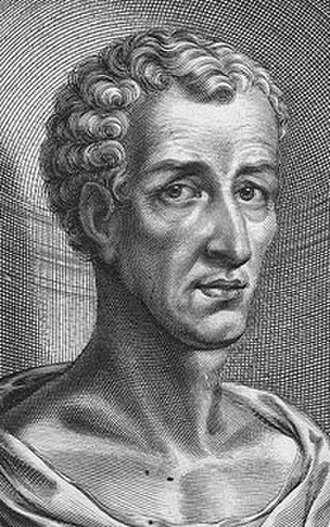
Lucian of Samosata
120–180 · Syrian satirist writing in Greek, one of the earliest comic writers in Western literature
Origins and early years
Lucian of Samosata was born around 125 in Samosata, a town on the banks of the Euphrates at the far eastern edge of the Roman Empire. Shortly before his birth, the former capital of the kingdom of Commagene had been annexed to the Roman province of Syria. Most of its inhabitants spoke Syriac, and this was probably Lucian's native tongue, although all of his surviving works are written in Greek. His family was of modest means and could not afford to give him a higher education.
Apprenticeship and a failed start
In The Dream, an oration that scholars treat as a literary piece rather than a reliable autobiography, he describes being apprenticed to his uncle to become a sculptor. His clumsiness ruined a statue, and the beating he received made him run away. During a dream that followed, the personifications of Statuary and Culture competed for him, and he chose Culture. Most scholars regard the account as largely fictional, as with other autobiographical hints in his work, since Lucian was a writer fond of irony.
Education and early career as a lawyer
Lucian mastered Attic Greek so thoroughly that he could parody the tragedians, Plato, rhetoricians, philosophers, and even the Greek of Homer. His rhetorical training probably took place in Ionia, the main centre of rhetorical teaching at the time. According to The Fisherman, he first tried to practise law, but was disillusioned by the deceit of the profession and resolved to devote himself to philosophy and sophistic instead.
Travels and public lectures
Under Marcus Aurelius he travelled around the Mediterranean giving public lectures in Greece, Italy and Gaul, for which he received high fees. In Gaul he may have held a well-paid official teaching post. Around 160 he returned to the East as a wealthy and famous man, visited Samosata, and was recorded in Antioch in 162 or 163. During his travels he married, and he mentions having a son.
Athens and literary maturity
Around 165 he bought a house in Athens and invited his parents to live with him. For about a decade he gave up most oral teaching and devoted himself to writing, in very pure Attic Greek. Nearly all of his most famous works were composed in this period. He also gave readings of his works in Greek cities such as Ephesus and Corinth. In 167, at Olympia, he witnessed the self-immolation of the Cynic philosopher Peregrinus Proteus, who threw himself on a pyre after delivering his own funeral oration. Lucian described the act with scorn in The Passing of Peregrinus, a text in which he also mocks the Christians.
Works and style
More than eighty works survive, some of disputed authenticity, on a wide range of subjects. The best known include A True Story, a satire on authors who tell incredible tales and often regarded as one of the earliest works of science fiction, with voyages to the Moon and interplanetary wars. Lucian is also credited with inventing the comic dialogue, a parody of the Socratic dialogue, in works such as The Dialogues of the Gods, The Dialogues of the Dead and Philosophies for Sale. His satire does not defend a fixed system of belief in the manner of Aristophanes; it ridicules the pomposity, falsehood and absurdity of its targets, and behind it lies a deep scepticism, reflected in his admiration for Epicurus and for the Cynic Menippus.
Final years and legacy
Around 175 he returned to lecturing, and soon afterwards accepted a secure and well-paid post in the Roman administration of Egypt as assistant to the governor for judicial affairs. He is thought to have died in Alexandria shortly after the death of Commodus in 192, though this is uncertain. His works were widely read in antiquity and in Byzantium. In the West his reputation was revived in the Renaissance, and his influence can be seen in Erasmus, Rabelais, Cervantes, Quevedo, Swift and Voltaire. Friedrich Engels called him "the Voltaire of classical antiquity", and a lunar crater bears his name.
Key ideas
- Radical scepticism: he distrusts every dogma, whether philosophical or religious, and defends no doctrine of his own.
- Satire against solemnity: he attacks pomposity, affectation and fraud among philosophers, priests and charlatans.
- The comic dialogue: he turns the Socratic dialogue into a parody in which gods and the dead take the stage.
- Criticism of credulity: he shows how people are repeatedly taken in by impostors and false prophets.
Where to start
The Dialogues of the Dead are a good entry point because they are brief, entertaining and direct. In thirty satirical conversations, historical and mythical figures already dead discuss vanity, power and fame, with agile humour that exposes Lucian's irony toward human pretension.
Next: Dialogues of the Gods. The Dialogues of the Gods apply the same satirical style to Olympus, showing the same mocking gaze on the sacred and the human.
Works in Filopedia
Books to read
- Lucian's True History EnglishEPUB 119 KBRead online
- The Works of Lucian of Samosata — Volume 04 EnglishEPUB 282 KBRead online
- Trips to the Moon EnglishEPUB 166 KBRead online
- The Works of Lucian of Samosata — Volume 01 EnglishEPUB 291 KBRead online
- The Works of Lucian of Samosata — Volume 03 EnglishEPUB 301 KBRead online
Curiosities
An unpromising sculptor
According to The Dream, he ruined a statue he was working on in his uncle's workshop, which led him to run away and seek a different education.
A death at Olympia
In 167 he watched Peregrinus Proteus throw himself onto a pyre, as the philosopher had announced he would. Lucian described the event with contempt.
A famous nickname
Friedrich Engels called him the Voltaire of the ancient world, a comparison often used to point to his mocking attitude towards religion.
Teachers and influences
Influenced
- Voltaire 1694–1778
- Machado de Assis 1839–1908
Original Filopedia text based on Wikipedia (es) and Wikipedia (en) and Wikidata.