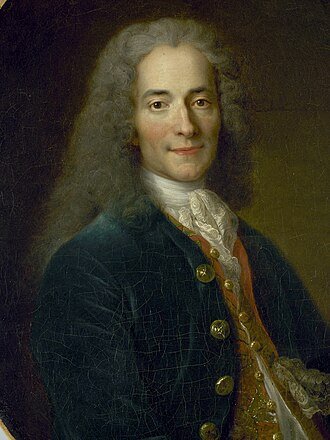
Voltaire
1694–1778 · French Enlightenment writer, philosopher and historian
Childhood and education
François-Marie Arouet was born in Paris on 21 November 1694, the son of a notary who later became a treasury official. His mother died when he was seven, and he was a sickly child. He studied with the Jesuits at the Collège Louis-le-Grand from 1704 to 1711, where he learned Latin, Greek and rhetoric, and made friends with boys who would later become royal ministers. His father wanted him to be a lawyer, so he studied law without finishing, convinced that literature was his vocation.
Paris and the Bastille
In the Parisian salons he made a name for himself through his wit and daring verse. After the death of Louis XIV he wrote a satire accusing the regent, the Duke of Orléans, of incest with his daughter. For this he spent eleven months in the Bastille, from May 1717 to April 1718, and used the time to study literature. During this imprisonment he conceived his first tragedy, Œdipe, which opened to great success in November 1718. It was then that he took the name Voltaire, a pseudonym whose origin is still debated. It has been suggested that it is an anagram of "L[e] J[eune]", the young Arouet, though other explanations have also been proposed, including a childhood nickname and wordplay on the syllables of his surname.
Exile in England
After a quarrel with the Chevalier de Rohan, who refused to fight a duel and had his servants beat Voltaire, he was again imprisoned in 1726 by a lettre de cachet. He was released on condition that he go into exile, and spent two and a half years in England, from 1726 to 1729. There he discovered Newtonian science, Locke's empiricist philosophy and a political system in which the monarch's power was checked by parliament and by law. He mixed with Pope, Swift and other writers, attended Newton's funeral in 1727, and became interested in Shakespeare, whom he admired while criticising his style. He returned to France with three aims: to get rich, to fight fanaticism, and to spread the ideas of Newton and Locke.
The Philosophical Letters and Cirey
The Philosophical Letters, published in 1734, praised religious tolerance, freedom of thought and British constitutional monarchy, contrasting them with French society. Parliament ordered the book burned, and an arrest warrant was issued against its author. Voltaire fled and took refuge at the château of Cirey, on the border of Champagne and Lorraine, with the Marquise Émilie du Châtelet, a mathematician and physicist with whom he kept up an intellectual and emotional partnership for sixteen years. There, with a library of around twenty-one thousand volumes, they studied modern science. Voltaire published Elements of the Philosophy of Newton, which made Newtonian physics accessible to the French public, and during these years he wrote tragedies such as Zaïre and Mérope.
Berlin, Geneva and Ferney
After the Marquise's death in 1749 he accepted an invitation from Frederick II of Prussia and settled at Potsdam as a chamberlain. Relations soured after a quarrel with the mathematician Maupertuis and a money dispute with a Jewish financier, and in 1752 Voltaire left the Prussian court. He was detained at Frankfurt by the king's agents, an episode he never forgot. He settled in Switzerland, first at Les Délices near Geneva and then, from 1758, at the estate of Ferney, on French soil very close to the border. From there he kept up an enormous correspondence, led his campaign against fanaticism, and published Candide (1759), his most famous work, a satire of Leibniz's optimism written in the wake of the Lisbon earthquake of 1755.
Public causes
At Ferney Voltaire became a European public figure. He intervened in judicial cases that caused great outrage, such as that of Jean Calas, a Protestant merchant wrongly condemned and executed in 1762, whose conviction he had overturned in 1765, or that of the Chevalier de La Barre, condemned for impiety. These campaigns helped discredit judicial torture and sustained his defence of tolerance. He published his Treatise on Tolerance (1763) and the Philosophical Dictionary (1764), works attacking dogma and ecclesiastical power. His historical writings, such as Essay on the Customs and the Spirit of Nations, sought a universal history that went beyond kings and battles to encompass the arts, customs and the progress of the human mind.
Last years and legacy
In 1778, aged 83, he returned to Paris for the premiere of his tragedy Irène and was received with an extraordinary ovation. He died on 30 May of that year. Because he was denied a Christian burial in the capital, his body was secretly interred at the abbey of Scellières. In 1791 the National Assembly transferred his remains to the Panthéon in Paris, recognising him as a forerunner of the Revolution. His work left a lasting mark on the defence of freedom of expression, religious tolerance, equality before the law and the critique of arbitrary power. His style, clear, ironic and built on short sentences, remains a model of polemical prose.
Key ideas
- Religious tolerance: he argued that no belief should be imposed by force and that fanaticism is the greatest threat to peaceful coexistence.
- Criticism of dogma: he used ridicule against superstition and against the religious and political institutions of his time, in the name of reason.
- Equality before the law: he held that justice must be the same for everyone, without distinction between nobles and commoners.
- Critical optimism: he rejected the idea that this is the best of all possible worlds and treated human suffering as a reality that reason must confront.
Quotes
“Think for yourself and let others enjoy the privilege to do so too.”
“We must cultivate our garden.”
Cándido o el optimismo
Where to start
Candide 1759
Candide is a brief, lively and witty tale that ironically follows its hero through a chain of misfortunes, all the while under the belief that we live in the best of all possible worlds. It is the most accessible entry point into Voltaire's thought, vividly showing his critique of optimistic metaphysics, dogmatic religion and war.
Next: Philosophical Dictionary. The Philosophical Dictionary gathers in short, polemical articles the ideas Voltaire develops narratively in Candide, allowing a deeper exploration of his views on religion, morality and politics.
Works in Filopedia
Books to read
- Candide EnglishEPUB 158 KBRead online
- Candide, ou l'optimisme FrenchEPUB 190 KBRead online
- Letters on England EnglishEPUB 159 KBRead online
- Zadig; Or, The Book of Fate EnglishEPUB 158 KBRead online
- Voltaire's Romances, Complete in One Volume EnglishEPUB 516 KBRead online
- The History of Peter the Great, Emperor of Russia EnglishEPUB 368 KBRead online
- Traité sur la tolérance FrenchEPUB 165 KBRead online
- Candido, o El Optimismo SpanishEPUB 153 KBRead online
- Notes de Voltaire et de Condorcet sur les pensées de Pascal FrenchEPUB 114 KBRead online
- Zadig, ó El Destino, Historia Oriental SpanishEPUB 137 KBRead online
- Micromegas EnglishGutenberg
- Toleration and other essays EnglishGutenberg
Curiosities
A disputed name
The origin of the name Voltaire is unclear. One theory links it to the nickname Petit Volontaire used by his family in childhood, while another sees it as an anagram of L.J., for «le jeune» (the young), followed by his surname.
A duel that never happened
After a verbal exchange with the Chevalier de Rohan, Voltaire retorted that his own name would be honoured while the nobleman's would sink into oblivion. Rohan refused to fight a duel and had Voltaire beaten.
Teachers and influences
Influenced by
- William Shakespeare 1564–1616
- Confucius 550 BC–478 BC
- Plato 428 BC–348 BC
- Isaac Newton 1643–1727
- Miguel de Cervantes 1547–1616
- John Locke 1632–1704
- Cicero 106 BC–42 BC
- Blaise Pascal 1623–1662
- Jean Racine 1639–1699
- Lucian of Samosata 120–180
- Pierre Bayle 1647–1706
- Nicolas Malebranche 1638–1715
- Ibn Tufayl 1110–1185
Influenced
- Johann Wolfgang von Goethe 1749–1832
- Friedrich Nietzsche 1844–1900
- Alexander Pushkin 1799–1837
- Denis Diderot 1713–1784
- Alessandro Manzoni 1785–1873
- Machado de Assis 1839–1908
- Émilie du Châtelet 1706–1749
Original Filopedia text based on Wikipedia (es) and Wikipedia (en) and Wikidata.