Philosophical Dictionary
philosophical dictionary (alphabetical collection of brief polemical essays) · 1764
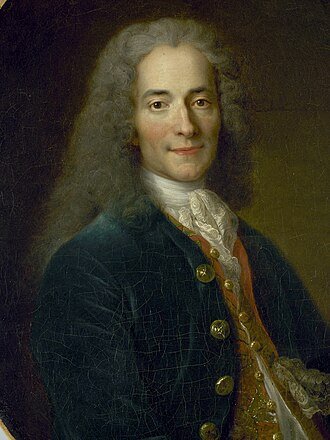 AuthorVoltaire1694–1778
Voltaire's Philosophical Dictionary, published in 1764, is a collection of short articles arranged alphabetically, in which the author sets out and defends his ideas on religion, morality, politics and knowledge. The first edition appeared in June 1764, anonymously and in Geneva, under the title Diccionario filosófico portátil, with 73 articles running from "Abraham" to "Virtue". Its origins go back to 1752, when a plan for a compendium of the philosophers' ideas, discussed at the court of Frederick II of Prussia, was never carried out. Voltaire later contributed to Diderot and D'Alembert's Encyclopédie, but judged that work too bulky to be an effective weapon. The portable and inexpensive format allowed him to spread his ideas more widely, and the book was conceived as a tool against what he called "the Infamy", that is, fanaticism and intolerance, above all religious ones.
The tone of the book is analytical, ironic and direct. Voltaire aims for concision and avoids digressions, so each article focuses on one question and advances a single argument. He defends a form of deism, which he calls theism, champions tolerance and freedom of the press, and denounces the abuses of the Catholic Church, though he also criticises superstition in other religions. Some articles chain together, one continuing or anticipating another, which gives the whole a certain programmatic intent. Through the 1760s the book was reissued often and grew to about 118 or 120 articles; the later additions sharpened its anti-Christian tone and made it more sarcastic, especially after the case of the Chevalier de La Barre.
The work enjoyed immediate success and strong condemnation. It was burned in Geneva, in Holland and in Bern, was condemned by the Parlement of Paris, and was placed on the Index of prohibited books. Nevertheless it circulated widely, and its ideas on tolerance and its criticism of dogma influenced later Enlightenment thought. It is now regarded as one of the most representative texts of Enlightenment thought and of Voltaire's polemical prose.
Themes
Other works by Voltaire
Original Filopedia text based on Wikipedia (es) and Wikipedia (en) and Wikidata.