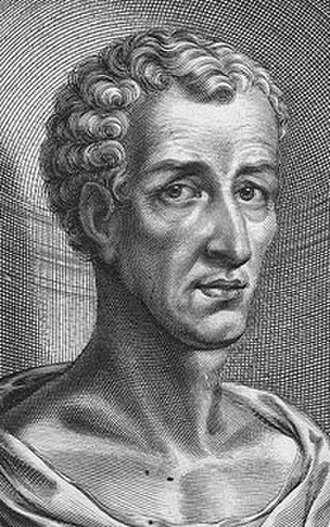
 AuthorLucian of Samosata120–180
On the Syrian Goddess is a Greek treatise of the second century AD that describes religious cults practiced at the temple of Hierapolis Bambyce, today Manbij in Syria. The work is written in an Ionic Greek in the manner of Herodotus and is traditionally attributed to the Syrian essayist Lucian of Samosata.
Its authorship has been debated. Lucian is known as a witty satirist, thanks to his many essays and dialogues, so the reliability of the treatise as a picture of religious life in second-century Syria has been questioned. If the author were not Lucian, however, the work could be more accurate than previously assumed. A more recent analysis concludes that Lucian is indeed the author, without this ruling out historical accuracy.
The text describes a worship of phallic character: devotees offered small male figures of wood and bronze, and huge phalluses rose before the temple like obelisks, which were climbed and decorated once a year. The work opens with a retelling of the Atra-Hasis flood myth, and castration and ritual sex took place within the precinct. It also describes a method of divination by the movements of a xoanon of Apollo, along with the temple's architecture, Ionic in style, with gold-plated doors and roof, and a lake of sacred fish, at the centre of which devotees decorated an altar.
Themes
Other works by Lucian of Samosata
Original Filopedia text based on Wikipedia (en) and Wikidata.