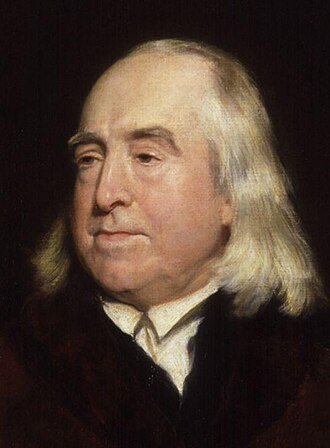
Jeremy Bentham
1748–1832 · English philosopher, jurist and social reformer, founder of modern utilitarianism
Early life
Jeremy Bentham was born on 15 February 1748 in Houndsditch, London, into a wealthy family that supported the Tory party. He was reportedly a child prodigy: as a toddler he was found sitting at his father's desk reading a multi-volume history of England, he began studying Latin at three, learnt the violin, and at seven was playing Handel sonatas at family dinners. He had one surviving brother, Samuel Bentham, with whom he remained close.
Education and early career
He attended Westminster School and, at twelve, his father sent him to The Queen's College, Oxford, where he took his bachelor's degree in 1764 and his master's in 1767. He trained as a lawyer and was called to the bar in 1769, though he never practised. He grew deeply frustrated with the complexity of English law, which he dubbed the "Demon of Chicane", and this frustration fuelled his conviction that the law needed to be rebuilt from its foundations.
In 1776, when the American colonies published their Declaration of Independence, the British government secretly commissioned the London lawyer and pamphleteer John Lind to write a rebuttal. The pamphlet included a short essay by Bentham, a friend of Lind, which attacked and mocked the Americans' political philosophy.
The Panopticon
In 1786 and 1787 Bentham travelled to Krichev in White Russia, now Belarus, to visit his brother Samuel, who was running industrial projects for Prince Potemkin. It was Samuel who first conceived a circular building at the centre of a larger complex, designed so that a few supervisors could oversee a large, unskilled workforce, and Jeremy later acknowledged this debt more than once. Bentham developed the model, particularly for prisons, and set out his ideas in letters to his father. He added the principle of contract management, in which the director would have a financial interest in lowering the mortality rate.
The scheme aimed to be cheaper than the prisons of its day, since it needed fewer staff, and prisoners could be put to work. Bentham spent some sixteen years refining it and hoped the government would appoint him contractor-governor of a National Penitentiary. After failed attempts in Ireland and revolutionary France, he won over William Pitt, who paid him £2,000 in 1794 for preliminary work. Sites at Battersea Rise, Hanging Wood and Tothill Fields were each rejected for legal or landowner objections. In 1799 the Crown bought land at Millbank, beside the Thames, which Bentham considered unhealthy and too small. When he asked for more land and money, the government would only accept a small experimental prison. Pitt resigned in 1801, and in 1803 the new Addington administration abandoned the project. Bentham wrote that "they have murdered my best days." The government revived the idea in 1811 and 1812, but by then Bentham, in his sixties, had given up on the role and claimed compensation, eventually receiving a modest £23,000.
The Panopticon was never built, yet its concept influenced later thinkers. The French philosopher Michel Foucault treated it as a paradigm of several nineteenth-century disciplinary institutions. Bentham remained bitter about its defeat, convinced that the King and an aristocratic elite had thwarted it. From this sense of injustice he developed the notion of "sinister interest", the private interests of the powerful conspiring against the public good, a idea that underpins much of his reformist argument.
Around the same time he worked with Patrick Colquhoun against corruption on the Pool of London, which led to the 1800 act creating the Thames River Police, the country's first preventive police force and a precedent for Robert Peel's reforms thirty years later.
Ideas and utilitarian doctrine
Bentham called his moral doctrine "deontology", the science of what is fitting. Today he is best known as the father of utilitarianism. His great ambition was a "pannomion", a complete code of law guided by the principle of utility, set out in his foundational work An Introduction to the Principles of Morals and Legislation (1789). There he argues that every act, rule and institution should be judged by the pleasure or pain it produces. He took as his fundamental axiom Helvétius's formula, "the greatest happiness of the greatest number", which he claimed to have borrowed from Joseph Priestley, though Priestley came closest to it in quite different wording.
To assess the consequences of a decision he proposed the "felicific calculus", weighing intensity, duration, certainty, propinquity, fecundity, purity and extent, and he classified twelve pains and fourteen pleasures. He held that punishment must be justified by its deterrent value and that needless laws could breed vices worse than those they aimed to suppress. Although he defended individual self-interest, he argued that legislation must align it with the common good. Critics, among them his disciple John Stuart Mill, faulted his view of human nature for ignoring conscience, and many have noted that his theory lacks a robust conception of justice.
Bentham was an atheist. He rejected revealed religion and natural law, which he called "nonsense upon stilts", although he regarded Magna Carta as important when he argued that the treatment of convicts transported to Australia was unlawful. He was also a sharp critic of legal fictions and a nominalist in the theory of knowledge.
He was an early advocate of animal rights. He argued that the decisive question is not whether animals can reason but whether they can suffer. In 1825, writing in the Morning Chronicle against critics of animal-welfare legislation, he accepted animal experimentation only where it had a beneficial and reasonable aim.
Reform of prisons, law and education
His proposals covered penal reform, poor relief, education, freedom of expression, the separation of church and state, equal rights for women, divorce, and the abolition of slavery, capital punishment and physical punishment, including that of children. In an unpublished essay he defended the decriminalisation of homosexual acts. In economics he favoured free markets and minimal public intervention, though he accepted some redistributive taxation.
His influence on the reform of prisons, schools, poor laws, courts and Parliament itself was considerable. He was also the centre of a circle of younger disciples known as the "Philosophical Radicals". With James Mill he founded the Westminster Review in 1823 to spread their ideas. His followers included James Mill, his son John Stuart Mill, the legal philosopher John Austin, John Bowring, whom he called his "son" and made his literary executor, and Edwin Chadwick, a major contributor to the Poor Law Amendment Act 1834. In 1792 France made him an honorary citizen, though he sharply criticised the natural-rights reasoning behind the Declaration of the Rights of Man and of the Citizen.
Private life and character
He never married, although he had several infatuations and wrote about sex. His character was idiosyncratic: a psychobiographical study by Philip Lucas and Anne Sheeran suggests he may have had Asperger syndrome. He kept a strict routine, rising at six, walking for two hours or more, and working until four in the afternoon.
Death and the auto-icon
Bentham died on 6 June 1832 at his home in Queen Square Place, Westminster, aged 84. He had left instructions for his body to be dissected and preserved as an "auto-icon", a memorial of himself. The physician Thomas Southwood Smith carried out the task. The skeleton, padded with hay and dressed in his own clothes and fitted with a wax head, has been kept since 1850 at University College London, where it is now displayed at the entrance of the Student Centre. He is regarded as the college's "spiritual founder", though his direct role in its foundation was limited.
Key ideas
- Greatest happiness: the right action is the one that produces the greatest happiness for the greatest number.
- Utilitarianism: laws and institutions should be judged by their practical consequences rather than by abstract principles.
- Critique of natural rights: rights are legal creations that should be extended through specific laws, not truths given by nature.
- Sinister interests: the interests of the powerful that oppose the public good are a main cause of injustice.
Curiosities
A precocious child
According to reports, at the age of seven he would perform Handel sonatas during family dinner parties.
A secretly commissioned rebuttal
The British government secretly commissioned the pamphleteer John Lind to answer the American Declaration of Independence, and Bentham wrote one essay in that pamphlet, which mocked the political philosophy of the Americans.
A preserved body
He left instructions for his body to be dissected and preserved as an 'auto-icon', which is now displayed at University College London.
Teachers and influences
Pupils
- John Stuart Mill 1806–1873
Influenced
- Joseph Priestley 1733–1804
- Claude Adrien Helvétius 1715–1771
- James Mill 1773–1836
- William Stanley Jevons 1835–1882
Original Filopedia text based on Wikipedia (es) and Wikipedia (en) and Wikidata.