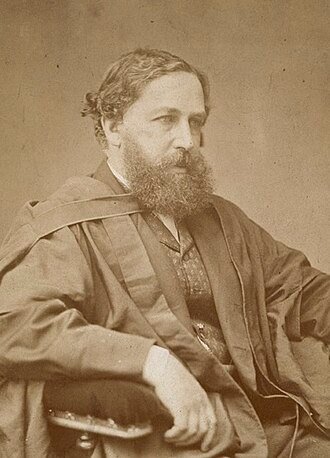
William Stanley Jevons
1835–1882 · English economist and logician, a figure of the marginal revolution
William Stanley Jevons (Liverpool, 1835 - Hastings, 1882) was an English economist and logician and one of the central figures of the marginal revolution of the late nineteenth century. He is associated with the idea that economics is largely a science of quantities that can be expressed mathematically, and with a new account of value based on the satisfaction a consumer gets from goods.
The son of a merchant, he saw the family firm fail in 1847, which pushed him to accept a post as assayer at the Sydney Mint, where he arrived in 1854 and first took an interest in political economy. He returned to London in 1859 and in 1866 was appointed professor of logic and of political economy at Owens College, Manchester. He sketched his theory of utility in 1862 and set it out fully in The Theory of Political Economy (1871).
His central claim is that the utility a good provides falls as a person acquires more of it. Jevons called this the final degree of utility, now known as marginal utility. He held that utility could only be compared in terms of ranking, though his calculations treated it as a quantity. Against the labour theory of value of the classical economists, he argued that labour affects value only indirectly, through supply and final utility, in what became known as his chain of causation. Goods whose supply cannot be increased, such as certain works of art or rare wines, showed him that value does not always depend on labour.
In The Coal Question (1865) he warned that Britain's coal reserves were being exhausted and observed that greater efficiency in using coal could increase total consumption, an idea now called the Jevons paradox. In logic, his The Principles of Science (1874) is his most important work on scientific method, and he built a mechanical logic machine, the logic piano.
He died in 1882, aged 47, drowning in the swimming pool of a spa he visited for his health. He left several unfinished books, and his planned treatise on economics appeared only in fragments after his death. His influence outlasted his number of followers: together with Menger and Walras, his ideas laid the foundations of modern marginalist economics, and his concern with resource depletion is still cited today.
Key ideas
- Marginal utility: the satisfaction gained from one additional unit of a good falls as a person already owns more units of it.
- Value and labour: labour affects value only indirectly, through supply and final utility, and does not determine it on its own.
- Mathematical economics: economics is a science of quantities whose relationships can be expressed with mathematical tools.
- Jevons paradox: greater efficiency in using a resource can raise its total consumption rather than reduce it.
Works in Filopedia
- The Coal Question 1865
Books to read
- The principles of science : a treatise on logic and scientific method EnglishEPUB 903 KBRead online
Curiosities
An unexpected death
Although his fragile health kept him in spas for long periods, he died at 47, drowned in the swimming pool of one of them.
The logic piano
He built a mechanical logic machine able to solve a complicated problem in less time than it took to solve it without the machine.
A paradox bearing his name
The paradox named after him describes how greater efficiency in using coal could increase its consumption.
Teachers and influences
Teachers
- Augustus De Morgan 1806–1871
Influenced by
- Jeremy Bentham 1748–1832
Influenced
- Alfred Marshall 1842–1924
Original Filopedia text based on Wikipedia (es) and Wikipedia (en) and Wikidata.