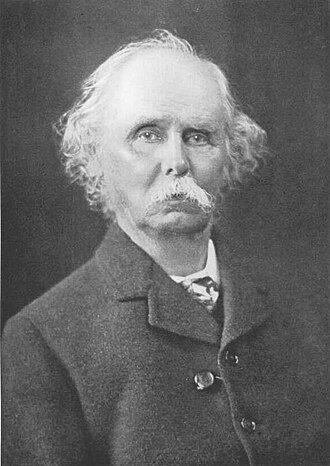
Alfred Marshall
1842–1924 · British economist, central figure of neoclassical economics
Alfred Marshall (London, 1842 – Cambridge, 1924) was the most influential British economist of his generation. Trained in mathematics and philosophy before turning to economics, he set out to bridge the classical English tradition of Smith, Ricardo, Malthus and Mill with the new marginalist theories. The result was the neoclassical school, whose vocabulary still underpins much of modern microeconomics.
He was born in Clapham, south London, the son of a clerk at the Bank of England. His family had a strict Evangelical background, and some scholars argue that this upbringing shaped his lasting interest in ethics and social welfare. At St John's College, Cambridge, he excelled in mathematics but, after a personal crisis, gave up physics for philosophy. It was through the utilitarian ethics of Henry Sidgwick that he arrived at economics, which he came to see as a means of improving the material conditions of the working class. After a brief spell at University College, Bristol, where he and his wife Mary Paley wrote Economics of Industry (1879), he taught at Oxford and, from 1885, at Cambridge, where he stayed until retiring in 1908. There he built the school that gave the Cambridge economists their reputation.
His major work, Principles of Economics (1890), became the leading textbook in the English-speaking world for many years. In it he combined classical notions such as value, labour and capital with the marginal utility of the marginalists. He argued that price emerges where supply, shaped largely by production costs, meets demand, shaped by marginal utility. His most lasting contribution was the distinction between fixed and variable costs and the idea that time changes which factors matter most: in the short run demand dominates, in the medium run variable costs, and in the long run the replacement of capital as well. He preferred partial equilibrium analysis to general equilibrium, judging it more useful for a dynamic economy, and he popularised the supply and demand diagrams still in use. Readers tended to see in him a careful synthesis rather than a rupture, and his influence reached Pigou, Keynes and, through the tradition he founded, much of modern economics.
Key ideas
- Marginal utility: the value a consumer places on a good falls with each additional unit acquired.
- Supply and demand equilibrium: market price emerges where what producers offer meets what buyers are willing to pay.
- Fixed and variable costs: the weight of each cost in the price depends on the time horizon considered.
- Partial equilibrium: it is more useful to analyse a single market, holding other things constant, than the economic system as a whole.
- Classical-marginalist synthesis: value depends both on production costs and on utility.
Works in Filopedia
Teachers and influences
Pupils
- John Maynard Keynes 1883–1946
Influenced by
- William Stanley Jevons 1835–1882
- Henry Sidgwick 1838–1900
Original Filopedia text based on Wikipedia (es) and Wikipedia (en) and Wikidata.