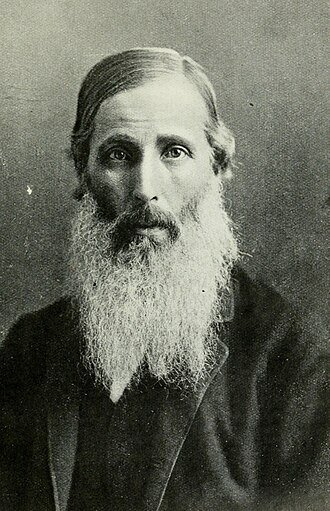
Henry Sidgwick
1838–1900 · English utilitarian philosopher and economist
Henry Sidgwick (Skipton, 1838 – Cambridge, 1900) was an English utilitarian philosopher and economist, and one of the central figures of late nineteenth-century British moral philosophy. His major work, The Methods of Ethics, is still regarded as a landmark of modern ethical theory, and his influence extends to economics and political thought.
He was born in Skipton, Yorkshire, where his father ran the local grammar school. He was educated at Rugby and then at Trinity College, Cambridge, where he joined the Cambridge Apostles. After an outstanding academic record, he taught classics at Trinity for a decade. In 1869 he switched to moral philosophy, and in the same year he gave up his fellowship because he could no longer honestly call himself a member of the Church of England. He was later elected Knightbridge Professor of Philosophy in 1883.
His 1874 book brought him recognition beyond the university. It examines common-sense morality and asks whether its decision procedures fit together. Sidgwick distinguished three methods: intuitionism, which relies on self-evident moral principles; egoistic hedonism, which pursues one's own happiness; and universal hedonism, or utilitarianism, which seeks the greatest good overall. He argued that intuitionism and utilitarianism can be harmonised, but that egoism sits uneasily with the general good unless one assumes a divine order to reconcile them. Finding no clear evidence for such an order, he concluded that we are left with a "dualism of practical reason".
In political economy he followed Bentham and Mill, and he was careful to separate positive from normative reasoning. Alfred Marshall regarded him as a decisive influence. He was also a committed advocate of higher education for women, helping to develop examinations and courses for them and supporting the house that became Newnham College. He was a founder and the first president of the Society for Psychical Research.
His influence has lasted. John Rawls praised his defence of classical utilitarianism and his comparative method as a model for studying ethics as an academic discipline. His reputation declined during much of the first half of the twentieth century, but it recovered its importance in contemporary moral philosophy.
Key ideas
- Universal utilitarianism: the right action is the one that maximises pleasure or well-being for everyone affected, without privileging anyone.
- Egoistic hedonism: each person pursues their own happiness, and Sidgwick regarded this as a rational position that deserved serious attention.
- Intuitionism: there are self-evident moral principles, such as the principle that one person's good is no more important than another's.
- Dualism of practical reason: the tension between self-interest and the general good cannot be fully resolved by reason alone.
Books to read
- The Methods of Ethics EnglishEPUB 611 KBRead online
Curiosities
Newnham College
Sidgwick helped support the student residence for women that later developed into Newnham College, Cambridge.
Teacher of Bertrand Russell
While at Cambridge, Sidgwick taught a young Bertrand Russell.
Teachers and influences
Influenced
- Alfred Marshall 1842–1924
Original Filopedia text based on Wikipedia (es) and Wikipedia (en) and Wikidata.