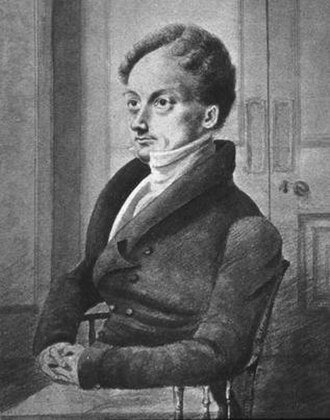
James Mill
1773–1836 · Scottish historian, economist and philosopher, father of John Stuart Mill
James Mill (Northwater Bridge, 1773 – London, 1836) was a Scottish historian, economist and philosopher, closely associated with Jeremy Bentham's utilitarianism and with the Ricardian school of economics. He matters chiefly for two reasons: he was the father and first teacher of John Stuart Mill, who would become the leading philosopher of British liberalism, and he wrote a historical work on India that shaped British views of that country for decades.
He was born into a modest household, the son of a shoemaker who also farmed a small plot. His mother, Isabel Fenton, was determined that he should have a first-rate education, so he attended the parish school and then the Montrose Academy, where he stayed until the unusually late age of seventeen and a half. He went on to the University of Edinburgh, where he made his name as a scholar of ancient Greek. He qualified as a preacher, but a church career did not materialise, and in 1802 he moved to London to devote himself to writing. Between 1803 and 1806 he edited the Literary Journal, which aimed to survey the main fields of human knowledge. He then contributed to the Edinburgh Review and other periodicals, and published on subjects ranging from the corn trade to the freedom of the press.
In 1808 he met Jeremy Bentham, who became his closest ally for many years. He embraced Bentham's principles almost in full and gave much of his energy to promoting them, working on education, prison discipline and social reform. In 1814 he set out the case for utilitarianism in articles for the supplement to the Encyclopaedia Britannica. His Elements of Political Economy (1821) helped make him one of the early popularisers of David Ricardo's ideas. In 1829 he published Analysis of the Phenomena of the Human Mind, an associationist study of the mind that engaged with the Scottish tradition of Thomas Reid and Dugald Stewart and shaped his son's method.
His best-known work is The History of British India, first published in 1817 or 1818 depending on the edition. It took him about twelve years to complete, and in it he divided Indian history into Hindu, Muslim and British periods, passing a harsh judgement on Indian society. Mill never visited India and worked from documents and archives. From 1819 he worked for the East India Company, rising to head of his office in 1830. The book, together with his administrative role, helped shape British policy in the region, and it has since been heavily criticised for its Eurocentric outlook and its prejudiced view of Indian people.
His influence runs mainly through John Stuart Mill, who inherited and reworked utilitarianism, and through nineteenth-century debates on the role of the state and of education in British liberalism. He is remembered today both for his ideas and for the controversies his historical writing provokes.
Key ideas
- Utilitarianism – actions and laws should be judged by their capacity to produce pleasure and prevent pain for the greatest number of people.
- Associationist psychology – the mind is built from sensations linked together by association, and its phenomena can be analysed as combinations of those associations.
- Institutional reform – education, a free press and prison discipline are areas where government should be guided by rational principles rather than tradition.
- Classical economics – a defence of the political economy principles of his time, with attention to rent, value and trade.
- History as the analysis of principles – history should be explained through general categories and not merely through the narrative of events.
Books to read
- Analysis of the Phenomena of the Human Mind EnglishEPUB 666 KBRead online
Curiosities
A determined mother
His mother, Isabel Fenton, wanted him to receive a first-rate education, so he was sent to an academy where he stayed until an unusually late age.
A history written without travelling
Mill never visited India: he wrote his History of British India from documents and archive records alone.
Teachers and influences
Pupils
- John Stuart Mill 1806–1873
Influenced by
- Jeremy Bentham 1748–1832
- David Hartley 1705–1757
- Dugald Stewart 1753–1828
Original Filopedia text based on Wikipedia (es) and Wikipedia (en) and Wikidata.