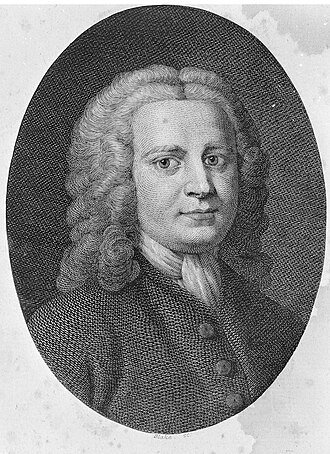
David Hartley
1705–1757 · British philosopher and physician, founder of associationist psychology
David Hartley (Halifax, 1705 – Bath, 1757) was an English philosopher widely regarded as the founder of associationist psychology. Working in the English Enlightenment, he wrote his major book, Observations on Man (1749), to explain the mind through natural laws, much as Newton had explained the motion of bodies.
Hartley studied at Cambridge and practised medicine in Newark, Bury St Edmunds, London and, finally, Bath. He married twice. His first wife, Alice Rowley, died shortly after giving birth to their son. With his second wife, Elizabeth Packer, he had two more children. He combined medicine with philanthropic causes, such as promoting smallpox inoculation and researching a remedy for bladder stones. After settling in Bath in 1742, he devoted much of his time to writing his great book.
His thinking starts from a simple idea: sensations leave traces in the nervous system, and when they recur together, those traces become linked. From this association come memory, imagination and the emotions, and even moral habits. Hartley tried to connect this psychological account with a physiological theory of nervous vibrations, partly inspired by Newton's speculations. For him, morality was not innate but the product of experience and associative processes, which places him close to thinkers such as Condillac.
The book has two parts: the first examines the structure of body and mind and how they influence each other; the second deals with human duties and expectations, in a hopeful, religious vein. Hartley believed in universal reconciliation, a view that set him apart from Anglican orthodoxy.
His influence was considerable. John Stuart Mill studied him closely, and the association of ideas became a central element of later British empiricism. Though he is now remembered less than Locke or Hume, he is a key figure for understanding eighteenth-century psychology.
Key ideas
- Association of ideas: experiences that occur together or in succession become linked, and this linking is the basis of mental life.
- Nervous vibrations: mental processes have a physical counterpart in vibrations of the nerves and brain.
- Acquired morality: feelings and moral principles form through association with pleasure and pain, and are not innate.
- Universal reconciliation: general happiness is, in his view, the end that both reason and Scripture confirm.
Curiosities
Declined to sign the Thirty-nine Articles
On graduating he refused to sign the Thirty-nine Articles, a requirement for ordination in the Church of England. His main disagreement was his belief in universal reconciliation.
A vegetarian in eighteenth-century England
He was a vegetarian, which was unusual for his time. His work on bladder stones also included a detailed account of his own suffering.
Teachers and influences
Influenced
- James Mill 1773–1836
Original Filopedia text based on Wikipedia (es) and Wikipedia (en) and Wikidata.