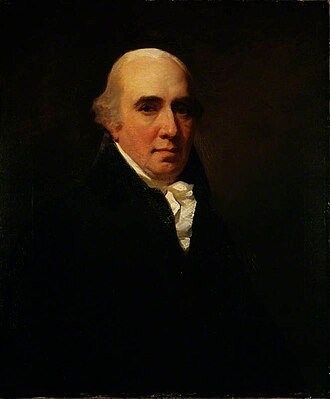
Dugald Stewart
1753–1828 · Scottish philosopher and mathematician of the later Scottish Enlightenment
Dugald Stewart (Edinburgh, 1753 – 1828) was a Scottish philosopher and mathematician, now regarded as one of the most important figures of the later Scottish Enlightenment. Trained in mathematics, medicine and philosophy, he became best known as a populariser of the work of Francis Hutcheson and Adam Smith, and his lectures at the University of Edinburgh reached far beyond the city through his many influential students.
He was the son of Matthew Stewart, professor of mathematics at Edinburgh. After studying there, he went to Glasgow to attend the classes of Thomas Reid, from whom he took much of his philosophical outlook. In 1775 he became joint professor of mathematics with his father, and in 1785 he succeeded Adam Ferguson in the chair of moral philosophy, which he held for twenty-five years. His course covered ethics and political philosophy and, from 1800, political economy. He was the first scholar to treat political economy as a field distinct from the theory of government, and after Smith's death he wrote the first account of his life.
His central aim was to build a philosophy of the mind on Francis Bacon's inductive method. Stewart argued that the phenomena of consciousness follow laws that can be discovered by observation, and that these laws explain how the mind is constituted and how it works. Among them he counted belief in personal identity, the continuity of the self, and the independent existence of the material world. Though he remained close to Reid, he drew on moderate empiricism and the French ideologists and rejected Condillac's sensationalism.
His later years were marked by loss. The death of his son in 1809 led him to give up teaching, and a stroke in 1822 affected his speech without dulling his mind, so he kept publishing until shortly before his death in Edinburgh in 1828.
His influence was considerable. His pupils included Walter Scott, Lord Palmerston and James Mill, and through them and his books he helped make the Scottish common sense philosophy dominant in European education in the early nineteenth century. In the Spanish-speaking world his work influenced Andrés Bello.
Key ideas
- Inductive philosophy of mind: consciousness is studied by observing its phenomena in order to discover the laws that govern it.
- Laws of the mind: principles such as belief in personal identity, the continuity of the self and the existence of the material world explain how the human mind works.
- Independent political economy: he separated its study from the theory of government, treating it as a branch of its own within political science.
- Moderate eclecticism: he took elements from moderate empiricism and the French ideologists while keeping a commonsense realism.
Curiosities
Friend of Robert Burns
In 1787 his friend and fellow Freemason Robert Burns made him an honorary member of Lodge St David in Tarbolton.
Monument on Calton Hill
In 1831 the city of Edinburgh erected a monument to him on Calton Hill, designed by William Henry Playfair.
Teachers and influences
Influenced
- James Mill 1773–1836
Original Filopedia text based on Wikipedia (es) and Wikipedia (en) and Wikidata.