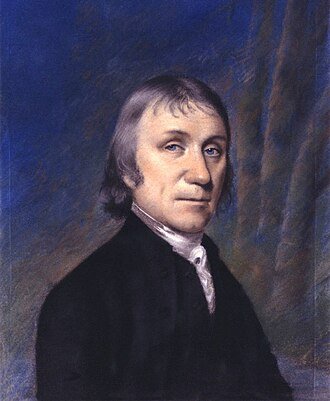
Joseph Priestley
1733–1804 · English chemist, theologian and Enlightenment thinker
Origins and early education
Joseph Priestley was born on 24 March 1733 (13 March in the Julian calendar then in use) at Birstall, near Batley, in the West Riding of Yorkshire, into an established English Dissenting family that did not conform to the Church of England. He was the eldest of six children of Mary Swift and Jonas Priestley, a cloth finisher. At about the age of one he was sent to live with his grandfather, and five years later, after his mother's death, he returned home. When his father remarried in 1741, the boy went to live with his aunt Sarah and her husband John Keighley, a wealthy childless couple at Heckmondwike.
Precocious, Priestley could recite all 107 questions and answers of the Westminster Shorter Catechism by the age of four, and his aunt sought the best education available to him, intending that he should become an Anglican minister. In his youth he attended local schools, where he learned Greek, Latin and Hebrew.
Religious crisis and a change of course
Around 1749 he fell seriously ill and feared for his life. Raised as a devout Calvinist, he believed that a conversion experience was necessary for salvation and doubted that he had had one. This anguish led him to question the doctrines of his upbringing: he rejected unconditional election and moved towards universal salvation. The elders of his local church refused to admit him as a full member. The illness also left him with a lasting stammer, and for the time being he abandoned any thought of entering the ministry.
His family prepared him to join a trading business in Lisbon, and he studied French, Italian and German, along with some Aramaic and Arabic. Under the Reverend George Haggerstone he was introduced to advanced mathematics, natural philosophy and logic, and he read authors such as Isaac Watts, Willem 's Gravesande and John Locke.
Daventry Academy
Priestley eventually resolved to resume his theological studies and in 1752 entered Daventry Academy, a training college for Dissenters in Northamptonshire. Because he was already well read, he was allowed to skip the first two years of the course. The liberal atmosphere of the school, together with his intense study, pushed his religious thinking further to the left, and he became a Rational Dissenter. Such men rejected dogma and mysticism and insisted on rational analysis of both the natural world and the Bible.
Priestley later wrote that the book that most influenced him, apart from the Bible, was David Hartley's Observations on Man (1749). Hartley proposed a material theory of the mind and aimed to build a Christian philosophy in which religious and moral truths could be scientifically proven, a goal that would occupy Priestley throughout his life. In his third year at Daventry he committed himself to the ministry, which he described as "the noblest of all professions".
Ministry and teaching at Needham Market and Nantwich
His first posting, in 1755, was to the Dissenting congregation at Needham Market in Suffolk. Robert Schofield, Priestley's major modern biographer, regards the appointment as a mistake for both Priestley and the congregation: Priestley longed for urban life and theological debate, while Needham Market was a small rural town with a congregation attached to tradition. When the extent of his heterodoxy became known, attendance and donations fell sharply, and his aunt withdrew the support she had promised.
In 1758 he moved to Nantwich in Cheshire, where his time was happier. The congregation minded his heterodoxy less, and he was able to open a school. Unlike many schoolmasters of his day, he taught natural philosophy and bought scientific instruments for his pupils. Dissatisfied with the English grammars then available, he wrote The Rudiments of English Grammar (1761). His innovations, particularly his effort to separate English grammar from Latin grammar, led twentieth-century scholars to describe him as one of the great grammarians of his age.
Warrington: teaching, friendships and marriage
In 1761 he settled at Warrington in Cheshire, where he became tutor in modern languages and rhetoric at the town's Dissenting academy, though he would have preferred to teach mathematics and natural philosophy. There he formed lasting friendships, among them with the doctor and writer John Aikin, his sister, the children's author Anna Laetitia Aikin, and the potter and manufacturer Josiah Wedgwood. Priestley and Wedgwood met rarely but exchanged letters, chemical advice and laboratory equipment.
On 23 June 1762 he married Mary Wilkinson of Wrexham, whom he described as a woman of excellent understanding, fortitude and affectionate temper, who relieved him of household concerns so that he could devote his time to study. Their first daughter, born in 1763, was named Sarah after his aunt.
History, pedagogy and early investigations
All the books Priestley published at Warrington stressed the study of history, which he considered essential both to worldly success and to religious growth. In his Essay on a Course of Liberal Education for Civil and Active Life (1765) and other works he argued that the education of the young should anticipate their future practical needs. This principle of utility led him to recommend modern languages over classical ones and modern history over ancient, unconventional choices for middle-class pupils. His lectures on history, providentialist and naturalist in tone, sought to reveal God's natural laws, and his millennial outlook was closely bound up with that view. In 1767 he is credited with inventing carbonated water, after devising a method of charging water with carbon dioxide gas.
Key ideas
- Fusion of reason and faith: Priestley sought to unite Enlightenment rationalism with Christian theism, convinced that studying nature reveals the action of God.
- Materialism and determinism: In his metaphysics he tried to reconcile a creator God with a material account of the mind and the idea that events follow from causes.
- Progress through knowledge: He believed that a correct understanding of the natural world would advance human progress and ultimately bring about the Christian millennium.
- Freedom of thought and tolerance: He defended the free exchange of ideas and equal civil rights for religious dissenters.
Curiosities
A meeting after a fall
Priestley met Josiah Wedgwood in 1762, after Wedgwood had fallen from his horse. The two exchanged letters and advice on chemistry, and Wedgwood later made a medallion bearing Priestley's likeness.
An illness with lasting effects
The serious illness of his youth left him with a permanent stammer, and for the time being he gave up the idea of entering the ministry.
Support withdrawn
His aunt had promised her support if he became a minister, but she withdrew it when she realised he was no longer a Calvinist.
Teachers and influences
Influenced by
- Jeremy Bentham 1748–1832
- John Amos Comenius 1592–1670
Original Filopedia text based on Wikipedia (es) and Wikipedia (en) and Wikidata.