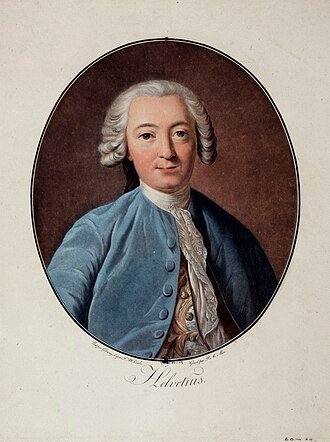
Claude Adrien Helvétius
1715–1771 · French Enlightenment philosopher, materialist and precursor of utilitarianism
Claude-Adrien Helvétius (Paris, 1715-1771) was a French philosopher of the Enlightenment, associated with the materialism and atheism of his time. Born into a family of physicians of Swiss origin, whose original surname Schweitzer appears Latinised as Helvétius, he is remembered above all for applying John Locke's empiricism to morals and politics, which places him among the precursors of utilitarianism.
His youth combined training for a career in finance with an early taste for poetry. By the age of twenty-three he had become a fermier général, a well-paid tax-farming post, and soon afterwards he married Anne-Catherine de Ligniville. Their salon, known as the Société d'Auteuil, drew many of the artists, scientists and writers of enlightened France. He later held a prestigious position at court as the queen's steward. He also took part in Diderot and D'Alembert's Encyclopédie.
His thought starts from the idea that all human faculties, including memory and judgment, arise from physical sensation. From this he drew an ethical conclusion: self-interest, understood as the pursuit of pleasure and the avoidance of pain, drives human conduct. Because that interest is external and can be shaped, the task of the lawmaker is to bring private interests into line with the common good through appropriate laws. Helvétius also held that all men have a broadly equal intellectual capacity, so that differences between individuals and peoples owe much more to education and government than to nature.
His principal work, De l'esprit (1758), was meant to rival Montesquieu's The Spirit of the Laws, and it challenged the claim that climate shapes the character of nations. The book caused a scandal. The Parlement of Paris condemned it, the Sorbonne censured it, and it was publicly burned. Helvétius issued several retractions, yet the book was translated into almost every European language. Other texts, such as De l'homme, appeared posthumously. Around 1765 he accepted an invitation from Frederick the Great to visit Berlin, and after leaving his post he devoted part of his fortune to relieving the poor on his estate. His influence can be traced in Bentham and Beccaria, and his materialism was later linked to the thought of Marx.
Key ideas
- Sensationism: all human faculties, including judgment and memory, originate in physical sensation.
- Self-interest: pleasure and pain are the springs of action, and personal interest is the starting point of all conduct.
- Common good: an action is useful to the extent that it produces well-being, and the challenge is to balance private interests with the general interest.
- Natural equality of minds: men are born with a similar intellectual disposition, and differences arise from the desire for instruction and from environment.
- Omnipotence of education: education and laws are the main instruments for reforming society.
Curiosities
A book burned in Paris
De l'esprit was publicly burned by the Paris hangman, even though its author had issued several retractions.
A jibe from Diderot
Diderot remarked that, if the book's claims were true, De l'esprit might just as well have been written by Helvétius's dog keeper.
Teachers and influences
Influenced by
- Jeremy Bentham 1748–1832
Influenced
- Cesare Beccaria 1738–1794
Original Filopedia text based on Wikipedia (es) and Wikipedia (en) and Wikidata.