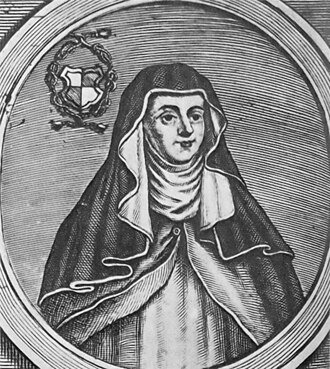
Hrotsvitha (also spelled Hroswitha or Hrosvit) was a canoness and writer who lived at Gandersheim Abbey, in what is now Lower Saxony, during the Ottonian period. She wrote in Medieval Latin, and she is considered the first woman since late antiquity to compose plays in that language.
Very little is known about her life. She probably came from an aristocratic family and entered Gandersheim as a young woman, a community known for its asceticism and its interest in learning. As a canoness she took vows of chastity and obedience but not of poverty, which allowed her to keep her own property. There she received a careful education, first under the nun Rikkardis and then under Abbess Gerberga, who encouraged her talent. Her name, read as clamor validus, or mighty shout, gave rise to the nickname the Nightingale of Gandersheim.
Her output includes hexameter legends about saints and martyrs, such as Pelagius and Agnes, and the legend of Theophilus, often seen as the first poetic treatment of the Faust story. Her six dialogues, written in response to Terence, present Christian virgins who resist temptation and keep their virtue. She also composed two historical works in Latin, one on the Ottonian dynasty and one on the founding of her abbey. Her poems lay forgotten for centuries until the humanist Conrad Celtes published them in 1501.
For a long time she was almost absent from histories of drama, but today she is studied as one of the earliest female literary voices in Europe and as a direct witness to the Ottonian court. Some feminist scholars have argued that doubts about the authenticity of her work reflect a gender bias rather than any real flaw in the texts.
Key works
- Gesta Ottonis (967): a hexameter epic recounting the history of Otto I up to 962.
- Gallicanus: a play in which a general of Constantine, still a pagan, seeks the hand of the emperor's daughter, who has already dedicated herself to the Lord.
- Dulcitius: a comedy in which a prefect of Diocletian tries to force three Christian maidens, only to be struck blind and left embracing sooty pots.
- Theophilus: a hexameter legend about a deacon who makes a pact with the devil and is rescued by the Virgin Mary.
Where to start
Paphnutius 1501
Paphnutius is an accessible starting point for the general reader: it tells the story of the courtesan Thaïs and her conversion through the hermit Paphnutius, a tale of repentance and redemption. It shows the religious and moral tone that characterizes Hroswitha, with lively dialogue and recognizable situations.
Next: Dulcitius. Dulcitius, a comedy with a comic and religious tone, reveals another side of the author and the range of her dramatic resources.
Works in Filopedia
- Dulcitius 1501
- Abraham 1501
- Paphnutius 1501
Curiosities
A prefect embracing pans
In Dulcitius, the prefect who plans to assault three maidens is struck blind and ends up embracing pots full of soot. The scene is comic, and it is one of the few places in her work where humor is openly used.
Rediscovered by a humanist
Her works were recovered at the monastery of St. Emmeram in Regensburg by the humanist Conrad Celtes. The first printed edition, published in 1501, was illustrated by Albrecht Dürer.
Teachers and influences
Influenced by
- Terence 184 BC–158 BC
Original Filopedia text based on Wikipedia (es) and Wikipedia (en) and Wikidata.