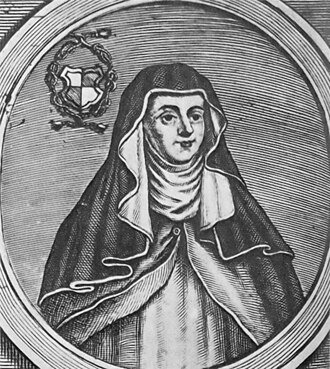
 AuthorHrotsvitha935–968
Paphnutius, also known as The Conversion of the Harlot Thaïs, is a play written in Latin by the Benedictine canoness Hrotsvitha of Gandersheim, from Saxony in northwest Germany, probably in the tenth century. It tells of the relationship between Saint Thaïs, once a courtesan in Alexandria in Roman Egypt, and Paphnutius the Ascetic, the hermit who offered her conversion to Christianity. Although its characters lived in the fourth century, the story of St. Thaïs became widely popular in Europe from the Early Middle Ages onward. Hrotsvitha evidently drew on the Vita Thaisis, a Latin translation made several centuries earlier of a Greek original, and shaped it into a narrative and a distinctive character suited to the medieval Christian worldview.
The play opens, perhaps unexpectedly, with a rather scholarly dialogue among clerics about the harmony inherent in the created world. This theme of concord frames the drama of Thaïs's disordered life: she is portrayed as a woman of great beauty and eager accumulation of wealth, whose greed leads her into prostitution. After her conversion she gives up her riches and burns other treasures before her former patrons, then withdraws into the desert to a convent under the guidance of an abbess, where she lives years of penitence.
The work reads Thaïs's sin less as a triumph of evil than as an inner imbalance between body and soul, and her conversion as the restoration of that harmony. It is regarded as one of the most distinctive works of medieval drama, and in the 1890s Alfred Jarry's Théâtre des Pantins staged it in a version featuring marionettes.
Themes
Other works by Hrotsvitha
Original Filopedia text based on Wikipedia (en) and Wikidata.