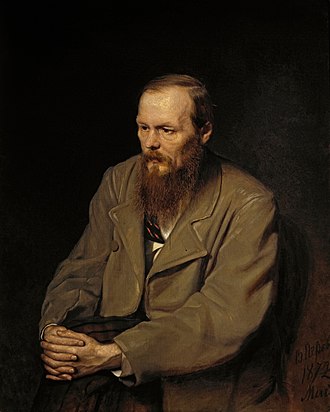
Fyodor Dostoyevsky
1821–1881 · Russian novelist, thinker and journalist
Fyodor Mikhailovich Dostoevsky (Moscow, 1821 – Saint Petersburg, 1881) was one of the great novelists of the Russian Empire and of world literature. He wrote in the second half of the nineteenth century, when Russia was undergoing a deep political, social and spiritual upheaval, and his fiction, though rooted in storytelling, takes up philosophical and religious questions. He matters because he placed the psychology of his characters at the centre of the novel, and his books are still read as explorations of the human conscience.
He was born into a family where his father worked as a doctor at the Mariinsky Hospital for the Poor in Moscow. His mother, who died of tuberculosis in 1837, encouraged his love of reading, and as a child he absorbed fairy tales, legends and books by Russian and foreign writers. In 1837 he and his elder brother entered the military engineering academy in Saint Petersburg, a place he disliked, since his real interests lay in literature rather than in science or soldiering. After graduating he worked briefly as an engineer and earned money by translating.
His first novel, Poor Folk, written in the mid-1840s, opened the doors of the capital's literary circles to him. In 1849 he was arrested for belonging to the Petrashevsky Circle, a group that discussed banned books. He was sentenced to death, but the sentence was commuted at the last moment. He spent four years in a Siberian labour camp, an experience he later drew on in The House of the Dead, and then served six years of compulsory military service in exile.
Back in Saint Petersburg he turned to journalism, founding and editing magazines and writing A Writer's Diary. His major novels of maturity, among them Crime and Punishment, The Idiot, Demons and The Brothers Karamazov, probe guilt, faith, rebellion and freedom. His characters often move between extreme ideas and contradictory passions, and the author lingers over the morbid mental states that lead to murder, humiliation and self-destruction. These books are also novels of ideas, in which philosophical and political debates take shape in concrete conflicts. Notes from Underground, published in 1864, is considered one of the first works of existentialist literature.
Dostoevsky's life was shaped by epilepsy, which he suffered for much of his adult life and which he wove into some of his characters, and by a gambling addiction that caused severe money troubles. He travelled around Western Europe, and at times had to beg to survive, yet he eventually became one of the most widely read and admired Russian writers.
His influence is vast. Friedrich Nietzsche regarded him as the only psychologist from whom he had learned something, and his work inspired writers such as Albert Camus, Jean-Paul Sartre, Anton Chekhov and Aleksandr Solzhenitsyn. He is also linked to the emergence of existentialism and to the development of Freudian thought.
Key ideas
- The divided conscience: people do not always act according to reason, and their choices arise from impulses, pride and contradictions that the novels examine without simplifying them.
- Guilt and redemption: suffering and a sense of guilt are presented as possible paths toward a kind of personal salvation.
- Freedom against reason: in Notes from Underground he questions the idea that human beings can be reduced to rational calculation and defends the right to one's own will.
- Faith and doubt: religion appears as a constant tension between belief, rebellion and the search for meaning.
Books to read
- The Grand Inquisitor EnglishEPUB 128 KBRead online
- Short Stories EnglishEPUB 289 KBRead online
- The Gambler EnglishEPUB 255 KBRead online
- The house of the dead : or, Prison life in Siberia EnglishEPUB 616 KBRead online
- Poor Folk EnglishEPUB 228 KBRead online
- Uncle's Dream; and The Permanent Husband EnglishEPUB 369 KBRead online
- Crime and Punishment EnglishGutenberg
- The Brothers Karamazov EnglishGutenberg
- El crimen y el castigo SpanishGutenberg
- White nights, and other stories EnglishGutenberg
- Notes from the Underground EnglishGutenberg
- The Idiot EnglishGutenberg
- The possessed : or, The devils EnglishGutenberg
- Stavrogin's Confession and The Plan of The Life of a Great Sinner With Introductory and Explanatory Notes EnglishGutenberg
- Sämtliche Werke 9-10 : Die Brüder Karamasoff GermanGutenberg
Curiosities
A commuted death sentence
He was sentenced to death in 1849, but the sentence was commuted at the last moment.
Nietzsche's praise
Friedrich Nietzsche called him the only psychologist from whom he had had something to learn.
Teachers and influences
Influenced by
- William Shakespeare 1564–1616
- Immanuel Kant 1724–1804
- Charles Dickens 1812–1870
- Miguel de Cervantes 1547–1616
- Alexander Pushkin 1799–1837
- Edgar Allan Poe 1809–1849
- Friedrich Schiller 1759–1805
- Honoré de Balzac 1799–1850
- Nikolai Gogol 1809–1852
- George Sand 1804–1876
- Adam Mickiewicz 1798–1855
- Mikhail Lermontov 1814–1841
- E. T. A. Hoffmann 1776–1822
- Nikolay Karamzin 1766–1826
- Alexander Herzen 1812–1870
- Vissarion Belinsky 1811–1848
- Vladimir Solovyov 1853–1900
Influenced
- Albert Einstein 1879–1955
- Leo Tolstoy 1828–1910
- Friedrich Nietzsche 1844–1900
- Anton Chekhov 1860–1904
- Albert Camus 1913–1960
- André Gide 1869–1951
- Mikhail Bakunin 1814–1876
- Knut Hamsun 1859–1952
- Ayn Rand 1905–1982
- Czesław Miłosz 1911–2004
- Saul Bellow 1915–2005
- Kazuo Ishiguro b. 1954
- Margaret Atwood b. 1939
- Charles Bukowski 1920–1994
- John Updike 1932–2009
- Philip Roth 1933–2018
- Norman Mailer 1923–2007
- Emil Cioran 1911–1995
- Jordan Peterson b. 1962
- Nikolai Berdyaev 1874–1948
- Mikhail Bakhtin 1895–1975
- Julius Evola 1898–1974
- Joyce Carol Oates b. 1938
- Lev Shestov 1866–1938
Original Filopedia text based on Wikipedia (es) and Wikipedia (en) and Wikidata.