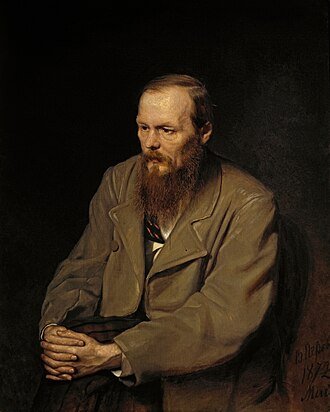
 AuthorFyodor Dostoyevsky1821–1881
The Double (in Russian, Двойник) is the second novel by Fyodor Dostoevsky, after Poor Folk. It first appeared on 30 January 1846 in the literary journal Otechestvennye zapiski, under the subtitle The Adventures of Mr. Golyadkin. When Dostoevsky revised it in 1865, he changed the subtitle to A Poem, and the work has since become known as "a Petersburg poem". Its early reception was lukewarm: many critics saw it as a clumsy attempt to imitate Nikolai Gogol, with whom it shares the theme of a minor civil servant crushed by the state machinery and high society.
The story follows Yakov Petrovich Golyadkin, a low-ranking titular councillor in Saint Petersburg who is desperate to get ahead. His doctor, Krestyan Rutenspitz, worries about his sanity and prescribes cheerful company as a remedy. Golyadkin resolves to try it and goes, uninvited, to a birthday party given by his office superior, where a chain of social blunders gets him thrown out. On his way home through a snowstorm, he meets a man who is exactly like him: his double. At first the two are almost friendly, but the younger Golyadkin, who has all the charm, smoothness and social skill the original lacks, begins to take over his place at the office and in his life, and the rivalry turns bitter. By the end, the protagonist sees replicas of himself everywhere, suffers a psychotic breakdown and is taken to an asylum.
The novel blends bureaucratic satire with an exploration of identity and freedom, handled in an ironic and at times cruel tone. For many readers, the double embodies freedom in its most impulsive form: desire, excess and deception. It is most often read as a work of transition in Dostoevsky's career, still rooted in Gogol's manner and in the German Romanticism of E. T. A. Hoffmann, yet already turning toward the inner psychology that would define his great later novels.
Its literary merit has long been debated. Dostoevsky himself wrote in A Writer's Diary that he had not succeeded with the novel, though he found its idea quite lucid and had never expressed anything more serious; as for its form, he judged that he had failed utterly. Vladimir Nabokov, who thought Dostoevsky a rather mediocre writer, nonetheless called The Double the best thing he ever wrote. The story has since been adapted for film, notably in the 2013 British film starring Jesse Eisenberg, and for BBC radio in a steampunk-styled nineteenth-century St. Petersburg.
Themes
Other works by Fyodor Dostoyevsky
- Poor Folk 1846
- The House of the Dead 1862
- Notes from Underground 1864
- Crime and Punishment 1866
- The Gambler 1867
- The Idiot 1869
- Demons 1871
- The Brothers Karamazov 1880
Original Filopedia text based on Wikipedia (es) and Wikipedia (en) and Wikidata.