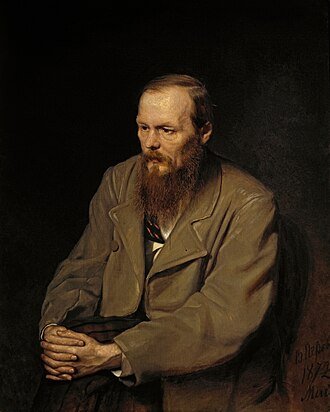
 AuthorFyodor Dostoyevsky1821–1881
Notes from Underground is a novella by Fyodor Dostoevsky, first published in 1864 in the journal Epoch, a publication Dostoevsky had founded together with his brother Mikhail. It was written during a period of great personal hardship for the author: the death of his wife, Maria Dmitrievna Isayeva, in April 1864, the subsequent death of his brother, the closure of his journals by the authorities, and a gambling addiction that brought serious financial problems.
The work presents itself as the memoirs of an unnamed narrator, a retired civil servant living in isolation in St. Petersburg, whom critics generally call the Underground Man. The novella has two parts. The first, titled "Underground," is essentially a monologue in which the protagonist sets out his views on human nature, natural law, rationalism and free will. He argues that people do not seek only well-being but also suffering and the freedom to choose even against their own interest. In this way he attacks determinism and rationalist utopias, and in particular the idea of a perfect society governed by enlightened self-interest, an ideal associated with Nikolai Chernyshevsky's novel What Is to Be Done?.
The second part, "Apropos of the Wet Snow," recounts episodes from the protagonist's youth: his obsession with an officer who once humiliated him, a farewell dinner organized by former school friends, the humiliation he suffers there, and his visit to a brothel, where he meets Liza, a young prostitute. Their relationship, marked by cruelty and guilt, ends painfully and reveals the protagonist's contradiction between his contempt for society and his inability to act otherwise.
The novella has a strong psychological dimension and is essential for understanding later works by the author, such as Crime and Punishment, Demons and The Gambler. Its portrait of a character aware of his own contradictions made it a forerunner of existentialism, admired by Friedrich Nietzsche, and an early model of the interior monologue. In the Soviet Union it was little valued by critics, since it challenged Marxist ideas about rationality and the satisfaction of human needs.
Themes
Books to read
- Notes from the Underground EnglishGutenberg
Other works by Fyodor Dostoyevsky
- Poor Folk 1846
- The Double 1846
- The House of the Dead 1862
- Crime and Punishment 1866
- The Gambler 1867
- The Idiot 1869
- Demons 1871
- The Brothers Karamazov 1880
Original Filopedia text based on Wikipedia (es) and Wikipedia (en) and Wikidata.