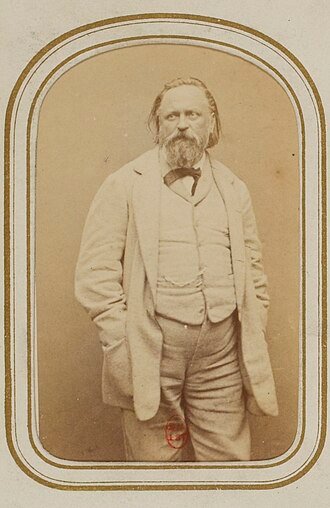
Alexander Herzen
1812–1870 · Russian revolutionary thinker and publicist
Alexander Herzen (1812-1870) was one of the first thinkers to shape Russian socialism and a key figure of agrarian populism. Born in Moscow shortly before Napoleon's invasion, he became a revolutionary democrat who fought tsarist absolutism and serfdom, and his name is linked to what is known as peasant socialism. His thought, materialist in orientation and strongly shaped by Hegel and Feuerbach, anticipated many debates about reform and revolution in nineteenth-century Russia.
He was the illegitimate son of a wealthy landowner, Ivan Yakovlev, and of a young Protestant German woman. He received the surname Herzen, which plays on the German word for heart. He studied at Moscow University, but in 1834 he was arrested for singing, at a party, songs by Sokolovsky that mocked Tsar Nicholas I. He was exiled to Vyatka and, after the intervention of the future Alexander II, was allowed to move to Vladimir, where he edited the city's official gazette. Back in Moscow he met the critic Vissarion Belinsky, who was strongly influenced by him. A clash with a police officer sent him to Novgorod, and in 1847 he left Russia for good.
Exile shaped his work. After stays in Italy, France and Switzerland, he settled in London, where he founded the Free Russian Press and the periodical Kolokol, which was widely read inside Russia despite censorship. Herzen argued that the Russian peasant commune could serve as a basis for moving from serfdom to socialism without passing through capitalism. This idealisation of the peasantry failed to foresee the role the industrial proletariat would come to play, and it set him apart from Marx's scientific socialism. He was also among the first Russian critics of bourgeois political economy, which he saw as a defence of capitalism and a means of depriving peasants of their land.
After the failure of the 1848 revolutions he wrote From the Other Shore, where he distrusted liberals who wanted freedom only for their own circle. His novel Who Is to Blame? and his memoir My Past and Thoughts, written between 1852 and 1870, are now landmarks of Russian literature. His influence reached the later populist movements and the philosopher Isaiah Berlin, who regarded him as a model for denouncing the sacrifice of people in the name of collective ideals. He died in Paris in 1870.
Key ideas
- Peasant socialism: the Russian rural commune could serve as a foundation for a socialist order without passing through capitalism.
- Critique of the bourgeoisie: middle-class values and liberal economics were used to justify inequality and the dispossession of the peasants.
- Individual freedom: the full development of the person is possible only in a socialist society that protects individual rights against the state.
- Rejection of grand narratives: distrust of historical projects that promise a predetermined destiny for society.
Works in Filopedia
- My Past and Thoughts 1861
Curiosities
A surname with meaning
His father gave him the surname Herzen because he was, as is believed, a "child of his heart", a play on the German word Herz.
A famous photograph
His cousin, the photography pioneer Sergei Levitsky, took a well-known portrait of him in 1860.
Teachers and influences
Influenced by
- Ludwig Feuerbach 1804–1872
Influenced
- Friedrich Nietzsche 1844–1900
- Fyodor Dostoyevsky 1821–1881
- Mikhail Bakunin 1814–1876
- Hristo Botev 1848–1876
- Ba Jin 1904–2005
Original Filopedia text based on Wikipedia (es) and Wikipedia (en) and Wikidata.