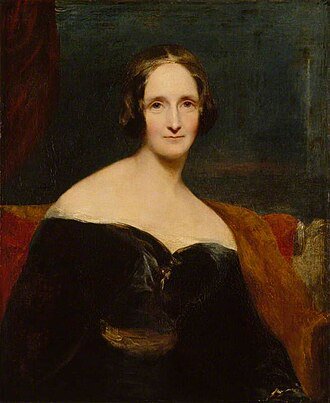
 AuthorMary Shelley1797–1851
Frankenstein; or, The Modern Prometheus is a novel by English writer Mary Shelley, published anonymously in London on 1 January 1818. It belongs to the Gothic tradition and reflects the Romantic movement, and its subtitle recalls the myth of Prometheus, since the protagonist seeks to snatch the spark of life from the divine. Although it is often regarded as one of the first works of modern science fiction, critics note that the genre had earlier precedents.
The book grew out of the summer of 1816, known as the year without a summer, when the eruption of Mount Tambora brought a cold climate to Europe. Mary Shelley, her husband Percy Bysshe Shelley, Lord Byron and the physician John Polidori were staying at the Villa Diodati on the shores of Lake Geneva, and Byron suggested that each of them write a ghost story. Polidori went on to write The Vampyre, an early work in the vampire genre, while Mary, after a waking dream, conceived a scientist who gives life to a creature and is horrified by what he has made. Conversations about galvanism and the electrical experiments of the period shaped the background of that vision. Percy Shelley helped revise the text, and in 1831 Mary published a rewritten version with stylistic changes and a more openly moral tone.
The novel follows Victor Frankenstein, a young student who, at the University of Ingolstadt, assembles human body parts and brings to life a huge and repulsive creature. Horrified, he abandons it. Rejected wherever it goes, the creature learns to speak and read by watching a rural family, and discovers who its creator is. Full of resentment, it demands that Victor make it a companion; when he refuses, the creature begins a chain of revenges that reaches Victor's loved ones. The story is told in the first person through two voices: Victor, who recounts his tragedy to a ship's captain in the Arctic, and the creature, who gives its own account.
The book raises questions about a creator's responsibility toward what he makes, the moral limits of science and the loneliness of the outsider. Its influence has been immense, giving rise to a vast body of novels, films and plays, and the name Frankenstein is now often wrongly used for the creature rather than its creator.
Themes
Other works by Mary Shelley
- The Last Man 1826
Original Filopedia text based on Wikipedia (es) and Wikipedia (en) and Wikidata.