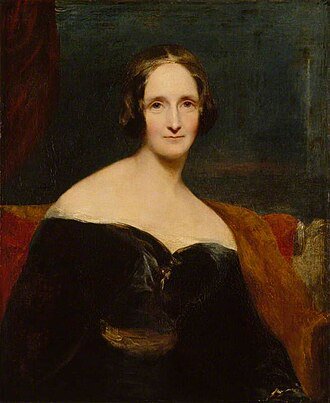
Mary Shelley
1797–1851 · British novelist, playwright and essayist
Early years
Mary Wollstonecraft Godwin was born in Somers Town, London, on 30 August 1797. She was the daughter of the philosopher and women's rights writer Mary Wollstonecraft and the philosopher and journalist William Godwin. Her mother died of a postpartum infection eleven days after the birth, and the girl was raised by her father together with her older half-sister, Fanny Imlay, the daughter of Wollstonecraft and the American speculator Gilbert Imlay. A year after his wife's death, Godwin published a set of Memoirs meant as a sincere tribute, but because they revealed Wollstonecraft's love affairs and her illegitimate child, they were received as scandalous.
Childhood and education
In 1801 Godwin married Mary Jane Clairmont, who brought two children into the household, Charles and Claire. The relationship between the young Mary and her stepmother was strained, and most of Godwin's friends described the new wife as quick-tempered. Mary's education was unconventional but remarkable for the period: she had a governess and a tutor, read her father's books on Roman and Greek history in the original, and grew up in a house frequented by intellectuals such as Samuel Taylor Coleridge. The family's finances, however, were precarious: the publishing firm the Godwins set up did not prosper, and the father came close to debtor's prison. In 1812 she spent time with the family of the dissenter William Baxter near Dundee, Scotland, where she later said her first genuine ideas and flights of imagination were born.
Percy Bysshe Shelley and the elopement
Mary met the poet Percy Bysshe Shelley, a political disciple of her father who was already married, around 1814. Shelley had become estranged from his aristocratic family because of his radical ideas and had failed to keep his promise to clear Godwin's debts, so Godwin felt betrayed. The young couple fell in love and, despite paternal opposition, eloped to France on 28 July 1814, accompanied by Claire Clairmont. They travelled through France and Switzerland in straitened circumstances, reading Mary Wollstonecraft and writing, until returning to England in September. Mary was pregnant, they had no money, and her father refused to help. Their letters from the period mix passion, isolation and grief, aggravated by repeated separations forced by creditors.
Loss and the Geneva summer
Her first daughter was born prematurely in February 1815 and died within days; the loss plunged her into deep depression. After another pregnancy, her son William was born in January 1816. In May of that year she travelled with Percy and Claire to Geneva to spend the summer near Lord Byron and his young physician John William Polidori. The rainy weather kept them indoors at the villa, and conversations about galvanism and the possibility of reviving dead matter, together with German ghost stories, led Byron to propose that each write a tale of the supernatural. Mary, unable at first to think of one, had a waking vision during the night that gave rise to Frankenstein. Percy encouraged her to develop what began as a short story, and the novel was published anonymously in January 1818. She later described it as the moment she stepped out of childhood into real life. Percy's influence on the text has been debated, though she always maintained the idea was her own.
Italy and years of exile
After the suicides of Fanny Imlay and of Percy's first wife Harriet, the couple married in December 1816. The Shelleys left England in 1818 and settled in Italy, where they lived a nomadic existence among Venice, Rome, Naples and the Tuscan coast. There they lost their children Clara, in 1818, and William, in 1819. During this period Mary wrote the autobiographical novel Matilda, the historical novel Valperga and plays. Her fourth child, Percy Florence, was born in November 1819. In 1822 Percy drowned when his sailing boat sank in a storm in the Gulf of La Spezia. Mary, waiting at Villa Magni, anxiously awaited news until bodies were found on the shore at Viareggio.
Widow and professional writer
She returned to England in 1823, where she had to negotiate with her father-in-law, Sir Timothy Shelley, for an allowance for herself and for the upbringing of her son, whom the baronet wanted placed under a guardian. Sir Timothy refused to meet her in person and dealt with her only through lawyers; he even threatened to withdraw the allowance if any biography of Percy were published. Mary turned to writing as a livelihood: she published the historical novels The Fortunes of Perkin Warbeck (1830), Lodore (1835) and Falkner (1837), and contributed to Dionysius Lardner's Cabinet Cyclopaedia and to women's magazines. In 1830 she sold the rights to a new edition of Frankenstein. She also edited her husband's poetical works in 1838, including biographical notes that got round her father-in-law's prohibition.
Final years and legacy
Sir Timothy died in 1844 and his grandson Percy Florence inherited the estate, giving mother and son a modest financial independence. Mary published the travel book Rambles in Germany and Italy (1844), and in these years she suffered several attempts at blackmail involving letters and documents from her circle. Her health had declined since 1839, with headaches and partial paralysis. She died in London on 1 February 1851, at the age of fifty-three, probably of a brain tumour. For nearly a century her fame rested chiefly on Frankenstein and her work as editor of Percy's poems. Since the 1970s feminist criticism and biographical studies have revalued her fiction, in which cooperation, compassion and the role of women in the family appear as alternatives to both Romantic individualism and her father's rationalism.
Key works
- Frankenstein; or, The Modern Prometheus (1818), a Gothic novel about a scientist who brings a creature to life and the moral consequences of that act.
- Valperga (1823), a historical novel set in medieval Italy, centred on a woman who holds power.
- The Last Man (1826), an apocalyptic novel imagining the extinction of humanity in the late twenty-first century.
- Perkin Warbeck (1830), a historical novel about the pretender to the English throne in the late fifteenth century.
Where to start
Frankenstein; or, The Modern Prometheus 1818
Frankenstein is the most accessible place to start: a Gothic novel with a framed narrative of letters and a story of creation, rebellion and guilt. The reader will find the dilemma of a scientist who gives life to a being he cannot accept, and a reflection on responsibility, loneliness and the limits of knowledge.
Next: The Last Man. The Last Man widens her vision to the future, with a plague that devastates humanity and a dystopian outlook quite different from the Gothic.
Works in Filopedia
Books to read
- Frankenstein; or, The modern Prometheus EnglishEPUB 287 KBRead online
- The Last Man EnglishEPUB 515 KBRead online
- Mathilda EnglishEPUB 205 KBRead online
- Tales and Stories Now First Collected EnglishEPUB 380 KBRead online
- History of a Six Weeks' Tour Through a Part of France, Switzerland, Germany, and Holland: With Letters Descriptive of a Sail Round the Lake of Geneva, and of the Glaciers of Chamouni. EnglishEPUB 123 KBRead online
- Eminent literary and scientific men of Italy, Spain, and Portugal. Vol. 3 (of 3) EnglishGutenberg
- Eminent literary and scientific men of Italy, Spain, and Portugal. Vol. 1 (of 3) EnglishGutenberg
Curiosities
A summer by Lake Geneva
In 1816, at a house near Geneva, Mary and Percy spent evenings with Lord Byron and John William Polidori. According to tradition, the challenge of writing a ghost story began there.
Ideas under the trees
In her 1831 introduction to Frankenstein she recalled that her truest ideas were born beneath the trees near the Scottish house where she lived, or on the nearby mountainsides.
Teachers and influences
Influenced
- Ray Bradbury 1920–2012
- Brian Aldiss 1925–2017
Original Filopedia text based on Wikipedia (es) and Wikipedia (en) and Wikidata.