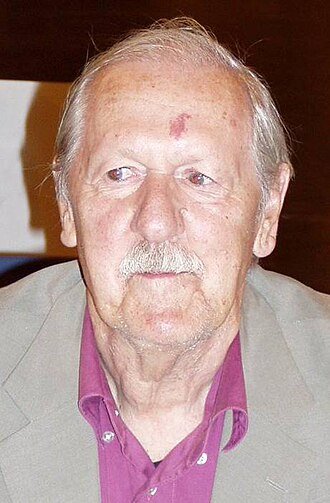
Brian Wilson Aldiss (Dereham, Norfolk, 1925 – Oxford, 2017) was an English writer of science fiction and one of the most recognised names of the British New Wave. Over a long career he wrote novels, short stories, anthologies and criticism, and he also became a serious painter. His work helps show how English-language science fiction moved, from the 1960s onward, away from gadget-driven adventure and towards a more experimental, formally ambitious kind of writing.
Born in 1925 above his grandfather's shop in Dereham, Norfolk, he was sent to boarding schools in Devon after the outbreak of the Second World War. As a boy he had come across the American pulp magazine Astounding Science Fiction, and he went on to read H. G. Wells, Robert Heinlein and Philip K. Dick. After wartime service in Burma, he returned to Oxford and worked as a bookseller. His first book, The Brightfount Diaries (1955), was a diary novel about life in a bookshop, published by Faber and Faber. His real break came with science fiction, and by 1957 he had published his first science fiction collection, Space, Time and Nathaniel, and had decided to write for a living.
In the 1960s he was closely associated with New Worlds, edited by Michael Moorcock, and he worked closely with J. G. Ballard. Novels from those years, such as Hothouse, which won a Hugo Award, and Cryptozoic!, show a growing interest in formal experiment, with echoes of James Joyce and William S. Burroughs. That direction cost him some readers, and in the early 1970s he turned to more conventional material. He also returned again and again to the classics: Frankenstein Unbound revisits Mary Shelley, and Moreau's Other Island revisits Wells, though critics were divided on both. The Helliconia trilogy, written in the 1980s, follows civilisations rising and falling across centuries on a planet with two suns, a structure some readers connected to Hegelian ideas of historical dialectic.
Aldiss was also a critic, an anthologist and later a painter. His Penguin Science Fiction anthologies and his annual Year's Best collections, edited with Harry Harrison, helped introduce many readers to the genre. He coined the phrase widescreen baroque in Billion Year Spree, a history of science fiction. His short story Supertoys Last All Summer Long became the basis of Spielberg's A.I. Artificial Intelligence, developed from a script by Stanley Kubrick. He received the Nebula Award in 1965 and was named a Grand Master by the Science Fiction Writers of America in 1999. He died in Oxford in August 2017, the day after his 92nd birthday.
Key works
- The Brightfount Diaries (1955), a diary novel about life in a bookshop.
- Non-Stop (1958), an early science fiction novel about a shipboard society that has forgotten it is on a voyage.
- Hothouse (1962), set on a far-future Earth dominated by vegetation; it won a Hugo Award.
- Cryptozoic! (1967), an experimental novel about the manipulation of time.
- Frankenstein Unbound (1973), a reworking of Mary Shelley's novel.
Where to start
Non-Stop 1958
Non-Stop is a good gateway to Aldiss because it is a direct, easy-to-read science fiction novel. It follows life aboard a generation ship whose inhabitants have forgotten they are travelling through space, and the reader uncovers its mysteries alongside the protagonist. It shows his style and concerns without requiring any prior background.
Next: Hothouse. Hothouse continues his blend of adventure and ecological reflection in a distant future, broadening the range of his imagination.
Works in Filopedia
Curiosities
Short story prize
In 1955, his story «Not for an Age» placed third in a competition run by The Observer for short stories set in the year 2500.
From story to film
His story Supertoys Last All Summer Long became the basis for Steven Spielberg's A.I. Artificial Intelligence, from a script developed by Stanley Kubrick.
Teachers and influences
Influenced by
- H. G. Wells 1866–1946
- Mary Shelley 1797–1851
- Karel Čapek 1890–1938
Original Filopedia text based on Wikipedia (es) and Wikipedia (en) and Wikidata.