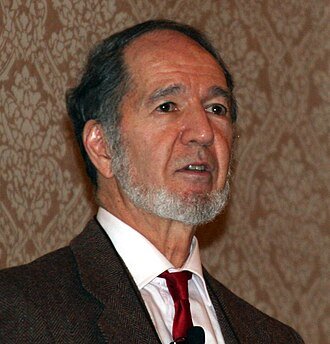
 AuthorJared Diamondb. 1937
The Third Chimpanzee is a popular science book by the physiologist and geographer Jared Diamond, first published in English in 1991. It gathers and reorganises, into a single coherent argument, a series of earlier articles in which Diamond examined the similarities and differences between humans and their closest relatives, chiefly chimpanzees. Its title makes a provocative point: since human and chimpanzee genes differ by only about 1.6 percent, less than the roughly 2.3 percent separating chimpanzees and gorillas, humans could reasonably be counted as a third species of the genus Pan, alongside the common chimpanzee and the bonobo. Diamond wryly notes that, by this logic, the cage in the zoo would carry the label Homo.
The book has five parts. The first considers what triggered the so-called Great Leap Forward, with particular attention to grammatical language, which Diamond links to the work of Derek Bickerton, and to sexual selection, hidden ovulation and hidden coitus, which he argues strengthened pair bonds and social life. He then turns to cultural features such as art, read in light of sexual selection, agriculture, which he shows was not an unqualified advance, and drug use, explained through the handicap principle. The fourth part addresses human expansion: Diamond attributes Eurasian dominance partly to the continent's east-west orientation, which let farming and animal-domestication packages spread easily, and to the disease resistance gained from long contact with domestic animals. Encounters between unequal civilisations often ended in the extinction of the weaker groups. The final part asks whether humanity will learn from its past and warns of environmental damage that technological progress may bring.
The book was widely admired for its breadth and accessible style, though some of its theses were seen as bold and speculative. The primatologist Frans de Waal praised its ability to bridge biology and the social sciences, while regretting that it overlooked some recent research, such as comparisons between the bonobo and human sexual behaviour. It won the Royal Society Prize for Science Books and the Los Angeles Times Book Prize in 1992.
Themes
Other works by Jared Diamond
Original Filopedia text based on Wikipedia (es) and Wikipedia (en) and Wikidata.