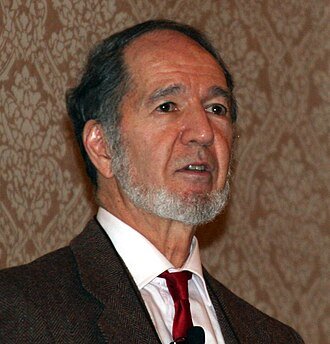
Jared Diamond
b. 1937 · American biologist, geographer and popular science writer
Jared Diamond (born in Boston in 1937) is an American author whose work crosses biology, geography, anthropology and history. Trained first in biochemistry and physiology, he became known for building bridges between disciplines to explain why some societies thrive while others fail. His reach extends well beyond academia, although specialists have often challenged his conclusions.
Diamond was born to Ashkenazi Jewish immigrants from Eastern Europe. His father was a physician of Bessarabian Jewish origin, and his mother was a teacher, linguist and concert pianist. As a child he studied piano and, according to a well-known anecdote, later proposed to his wife after playing her Brahms's Intermezzo in A major. By the age of seven he had taken up birdwatching, a passion that led to published work in ornithology. He graduated from Harvard in 1958 and earned a PhD at Cambridge in 1961 with a thesis on the physiology of membranes in the gallbladder. He returned to Harvard, and in 1968 joined the physiology faculty at UCLA.
His career unfolded in overlapping stages: physiology, then ornithology and ecology, with fieldwork in New Guinea from 1964, and finally, in mid-career, environmental history. That range is why he is often described as a polymath. In his popular books he gathers evidence from anthropology, genetics, ecology and linguistics to answer very broad questions. His explanations rely on material factors such as climate, the availability of domesticable plants and animals, and the orientation of continents, though he insists that human choices also shape what happens to societies.
The Third Chimpanzee (1991) brought him a general readership, and Guns, Germs, and Steel (1997) became an international bestseller and won the 1998 Pulitzer Prize for general nonfiction. Collapse (2005) looked at past societies that vanished or struggled, among them the Maya and the people of Easter Island, while The World Until Yesterday (2012) compared the practices of traditional societies with those of the industrial world. His work has drawn sharp criticism from historians, anthropologists and geographers, who point to factual and logical errors and to oversimplified portrayals of specific cultures. Some of his ideas, especially the notion that tribal societies are static, remain heavily contested.
His legacy lies mainly in public debate. He popularised the idea that geography and ecology shape history, and many readers know him through his books and the television documentaries based on them. He retired from UCLA in 2024. His work serves both as an engaging starting point and as a case study in the limits of popular history.
Key works
- The Third Chimpanzee (1991): examines human evolution and its relevance to the modern world, drawing on anthropology, genetics and ecology.
- Guns, Germs, and Steel (1997): explains why some Eurasian peoples came to dominate others, focusing on geography, domestication and resources.
- Why Is Sex Fun? (1997): explores the evolutionary roots of human sexual traits that are unusual among our animal relatives.
- Collapse: How Societies Choose to Fail or Succeed (2005): studies past societies that either collapsed or endured, from an ecological perspective.
- The World Until Yesterday (2012): compares how traditional societies handle universal problems such as child-rearing, disputes and old age.
Where to start
Guns, Germs, and Steel is a good entry point because it poses a clear, accessible question: why some societies came to dominate others throughout history. Diamond surveys thirteen thousand years of human history and explains the differences through geographical, environmental and biological factors, without resorting to racial explanations.
Next: Collapse: How Societies Choose to Fail or Succeed. Collapse is a natural next step, as it returns to Diamond's environmental and comparative lens to study why some societies disappear while others endure.
Works in Filopedia
Curiosities
A proposal set to music
According to a well-known story, Diamond proposed to his wife after playing her Brahms's Intermezzo in A major.
Birds from the age of seven
His interest in birdwatching began at seven and later produced published work in ornithology.
Teachers and influences
Influenced
- Yuval Noah Harari b. 1976
Original Filopedia text based on Wikipedia (es) and Wikipedia (en) and Wikidata.