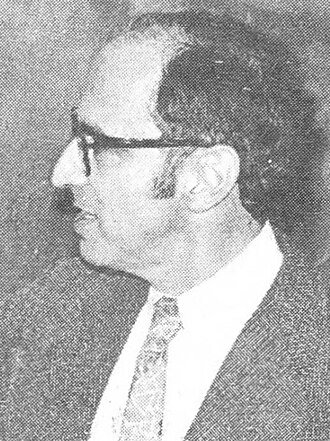
Thomas Kuhn
1922–1996 · American philosopher and historian of science
Thomas Samuel Kuhn (Cincinnati, 1922 – Cambridge, 1996) began as a physicist and ended up as one of the most influential historians and philosophers of science of the twentieth century. In the 1960s his work reshaped how philosophers and sociologists understood scientific knowledge, replacing the picture of steady, cumulative progress with one of long calm periods interrupted by deep upheavals.
He grew up in a Jewish family that was not strictly observant, and he attended progressive private schools that valued independent thinking over memorising facts. He studied physics at Harvard, where he earned his doctorate in 1949 under John Van Vleck. As a Junior Fellow he enjoyed three years of nearly complete academic freedom, and it was then that he moved toward the history of science. Teaching a history of science course at Harvard, at the invitation of president James B. Conant, forced him to confront how scientific ideas take shape within their own historical context. His career went on through Berkeley and Princeton, and he retired from the Massachusetts Institute of Technology in 1991.
His central book, The Structure of Scientific Revolutions, appeared in 1962. Kuhn argued that science moves through distinct phases. A pre-paradigm stage lacks a shared framework. Then comes normal science, in which researchers work within a paradigm: a set of shared commitments, models and methods that defines which problems are worth solving and how to solve them. When anomalies pile up and the paradigm can no longer cope, a crisis arises, and it may be resolved by a revolution in which a new paradigm replaces the old one and reorganises the field. Kuhn noted that results contradicting a paradigm are usually blamed on the researcher rather than abandoning the framework at once. He also held that rival paradigms are incommensurable, lacking a neutral vocabulary in which they can be compared point by point. Many critics read this as a threat to rational theory choice, and he rejected the strongly relativist reading in later editions.
In his final years he moved away from the language of paradigms and adopted a quasi-Darwinian view of scientific specialisation, in which disciplines diverge and narrow their subject matter. He kept the idea of incommensurability to the end. He died in 1996, after a diagnosis of cancer of the bronchial tubes and throat.
His influence has been vast. He popularised the phrase "paradigm shift", which is now used far beyond science, and he transformed the study of science in history and sociology. His ideas have been applied in international relations, the sociology of knowledge and the humanities, and they have shaped how scientists themselves perceive change in their fields.
Key ideas
- Paradigm: a set of shared commitments within a scientific community, covering theoretical beliefs, models of problem-solving and accepted methods.
- Normal science: the routine work of solving puzzles within an accepted paradigm, aimed at extending it rather than challenging it.
- Anomaly and crisis: results that do not fit accumulate until the paradigm loses its explanatory power, opening a period of crisis.
- Scientific revolution: the replacement of one paradigm by another that reorganises the field, rather than smooth, cumulative progress.
- Incommensurability: the claim that rival paradigms share no neutral language in which they can be compared point by point.
Where to start
The Structure of Scientific Revolutions 1962
It is Kuhn's most representative work and the best entry point to his thought. It explains how science advances not only through gradual accumulation but through paradigm shifts: periods of normal science, anomalies that build up, and revolutions that replace one worldview with another. The reader will find key concepts such as 'paradigm' and 'incommensurability'.
Next: The Copernican Revolution. After the general analysis of revolutions, this concrete historical study shows how the shift from ancient astronomy to the Copernican system actually unfolded.
Works in Filopedia
Curiosities
Interview with Niels Bohr
Kuhn interviewed and tape-recorded the Danish physicist Niels Bohr the day before Bohr died.
A book that popularised a phrase
Although he did not coin the word «paradigm», his 1962 book did so much to spread it that it is now part of everyday language.
Teachers and influences
Influenced by
- Jean Piaget 1896–1980
- Michael Polanyi 1891–1976
Original Filopedia text based on Wikipedia (es) and Wikipedia (en) and Wikidata.