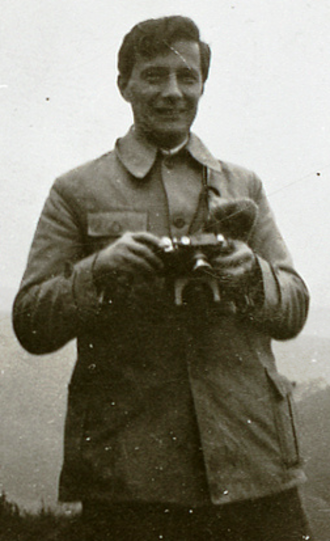
Michael Polanyi
1891–1976 · Hungarian-British philosopher and polymath
Michael Polanyi (Budapest, 1891 – Northampton, 1976) was a Hungarian-British polymath who worked in physical chemistry, economics and philosophy. Born Mihály Pollacsek into a secular Jewish family, he belonged to a generation that, early in the twentieth century, sought to reconcile scientific rigour with a broader understanding of human knowing. His work matters today for its critique of positivism and its defence of intellectual freedom against the state planning of science.
He studied medicine in Budapest and served as a medical officer in the Austro-Hungarian army during the First World War. While recovering from diphtheria in 1917 he wrote a thesis on adsorption, which earned him a doctorate in 1919. After the collapse of the Hungarian Soviet Republic he left for Germany, where he worked alongside Fritz Haber in Berlin and came to head a department of physical chemistry. When the Nazis rose to power he moved to Manchester, first teaching chemistry and later social science. He was elected to the Royal Society in 1944 and, on retiring, joined Merton College, Oxford.
In experimental science he contributed to chemical kinetics, X-ray diffraction and the adsorption of gases. In 1934 he linked the plastic deformation of metals to the dislocations described by Vito Volterra, an insight central to solid mechanics. His best-known philosophical claim is that all knowledge is personal: the scientist does not apply a mechanical method that delivers truth, but commits to fallible hypotheses guided by judgments he cannot always put into words. To explain this he coined the notion of tacit knowing, passed on largely through practice and imitation of a master, which he held lies behind even the meaning of words.
In economics he argued that scientific research works as a spontaneous order, in which scientists coordinate themselves much as agents do in a free market, and that science thrives when it can pursue truth without political direction. Set out in The Logic of Liberty (1951), this idea brought him close to Friedrich Hayek, though Polanyi insisted that spontaneous orders come in higher and lower forms.
His influence is visible in twentieth-century philosophy of science, especially in Thomas Kuhn and Paul Feyerabend, and in the debate over the role of tradition and practice in knowledge.
Key ideas
- Personal knowledge: all knowing depends on the judgments and commitments of the knower, and no absolute objectivity can be guaranteed by method alone.
- Tacit knowing: we know more than we can articulate, and much knowledge is transmitted through direct apprenticeship and guided practice.
- Critique of positivism: science cannot be reduced to rules or sense data, and positivism ignores the role of the investigator's responsibility and passion.
- Spontaneous order: the scientific community coordinates itself like a market, and freedom of debate is a condition of its progress.
- Fallibilism: even our firmest beliefs may be mistaken, yet we aim at a truth that exceeds our capacity to grasp it fully.
Curiosities
A family salon
His mother, Cecília Polányi, ran a salon well known among Budapest's intellectuals, which continued until her death in 1939.
On the Nazi search list
He was among some 2,300 names on the Nazis' Special Search List, people who were to be arrested and handed to the Gestapo during an invasion of Britain.
Teachers and influences
Influenced
- Thomas Kuhn 1922–1996
Original Filopedia text based on Wikipedia (es) and Wikipedia (en) and Wikidata.