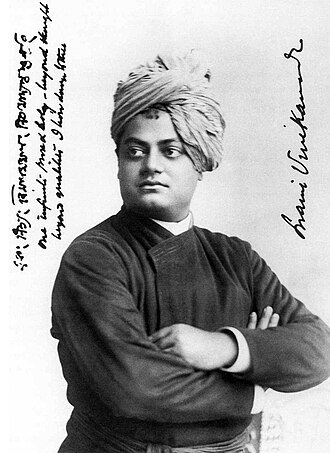
Swami Vivekananda
1863–1902 · Indian monk, thinker and religious leader, chief disciple of Ramakrishna
Birth and early years
Narendranath Datta was born on 12 January 1863 in Calcutta, into a Bengali family of the aristocratic Kayastha caste. His father, Vishwanath Datta, was an attorney at the Calcutta High Court, and his mother, Bhubaneswari Devi, a devout woman. The combination of his father's progressive, rational outlook and his mother's religious temperament shaped his character. As a child he was precocious, with an excellent memory, and he liked to meditate before images of gods such as Shiva, Rama and Hanuman. He was mischievous and restless, to the point that his mother is said to have remarked that she had prayed to Shiva for a son and had been sent one of his demons.
Education
In 1871 he enrolled at Ishwar Chandra Vidyasagar's Metropolitan Institution. After a period in Raipur, he returned to Calcutta in 1879 and was the only student to gain first-division marks in the Presidency College entrance examination. He was a voracious reader of philosophy, religion, history, social science, art and literature, and of the Vedas, Upanishads, Bhagavad Gita, Ramayana, Mahabharata and Puranas. He trained in Indian classical music and took part in gymnastics and sport. At the General Assembly's Institution he studied Western logic, philosophy and European history, and took his bachelor's degree in 1884. He read Hume, Kant, Fichte, Spinoza, Hegel, Schopenhauer, Comte, Mill and Darwin, and was especially drawn to Herbert Spencer's evolutionism, corresponding with him and translating his book Education into Bengali. His teacher William Hastie regarded him as a genius.
Spiritual search and meeting Ramakrishna
Before meeting Ramakrishna, Narendra moved in Brahmo Samaj circles, especially those of Keshab Chandra Sen, whose monotheistic and rationalist ideas marked his early convictions. He asked a number of prominent people whether they had seen God and was dissatisfied with their answers. Around 1881 he met Ramakrishna at Dakshineswar, who told him that he saw God as clearly as he saw him, and that tears shed for God were the only ones truly worth shedding. Narendra at first rejected his visions and his worship of Kali, and mocked the Advaita idea of identity with the Absolute. Ramakrishna asked only that he try to see the truth from every angle. After years of testing him, Narendra accepted him as his guru. His father's death in 1884 left the family in financial ruin, and during this hard period he found in Ramakrishna crucial support.
Monastic life and travels in India
After Ramakrishna died in August 1886, his disciples founded a modest monastery at Baranagar, the first house of the Ramakrishna order. In December 1886, at Antpur, Narendra and eight other disciples took monastic vows. In 1888 he left the monastery as a wandering monk, a parivrajaka, carrying a water pot, a staff and two books, the Bhagavad Gita and The Imitation of Christ. For five years he travelled the subcontinent, sleeping in palaces and in huts, and observed closely the poverty and caste inequalities of the country. At Khetri, the maharaja Ajit Singh suggested the name Vivekananda, roughly 'the bliss of discernment'. In December 1892 he reached Kanyakumari, where, by his own account, he meditated for three days on the past, present and future of India.
The Parliament of the World's Religions in Chicago
Encouraged by people in Madras and by some princes, Vivekananda sailed for the United States in May 1893 to take part in the World's Parliament of Religions in Chicago. Lacking credentials, he was told by Professor John Henry Wright of Harvard, who thought him an extraordinary man, that asking for his credentials was like asking the sun to justify its right to shine. On 11 September 1893 he gave his famous address beginning 'Sisters and brothers of America', and received an ovation of nearly two minutes. He argued for religious tolerance and universal acceptance. The press called him an orator by divine right and the greatest figure of the Parliament.
Activity in the West
In the following years he lectured across the United States and Britain, and in 1894 founded the Vedanta Society in New York. He gave free classes in Vedanta and yoga, and in 1896 published Raja Yoga, an interpretation of Patanjali's Yoga Sutras that had a lasting influence on the Western understanding of yoga. He met Margaret Noble, who became Sister Nivedita, and the Indologist Max Müller. He declined professorships at American universities so as not to compromise his monastic life. His success also brought criticism, partly from Christian missionaries whom he attacked sharply.
Return to India and social work
He returned to India in 1897 and was welcomed with enthusiasm. In his Lectures from Colombo to Almora he called for national renewal, the abolition of caste discrimination, the promotion of science and industry, and the fight against poverty. He founded the Ramakrishna Mission, devoted to social service, and the Ramakrishna Math, a monastic order for spiritual training, based at Belur. He also launched the journals Prabuddha Bharata and Udbodhan, and supported famine relief in Murshidabad. With equal energy he travelled to the West again between 1899 and 1900, founded centres in San Francisco and New York, and attended the Congress of Religions in Paris.
Death and legacy
His health, undermined by asthma, diabetes and insomnia, worsened in his last years. On 4 July 1902, after meditating and teaching his disciples, he suffered a cerebral haemorrhage and died at Belur Math at the age of thirty-nine. His followers interpreted his death as mahasamadhi, final absorption in God. His thought combined Advaita Vedanta with the practice of yoga and an ethic of service to others, which he called daridra narayana seva, service to God in the poor. He is regarded by many as one of the great modern Indian thinkers. He inspired figures such as Gandhi, Tagore, Subhas Chandra Bose and Sri Aurobindo, and his birthday is observed in India as National Youth Day.
Key ideas
- Advaita Vedanta: ultimate reality (Brahman) is one, and the individual self (atman) is not different from it.
- Unity of religions: all spiritual paths lead to one truth, and none should be imposed on the others.
- Service as spirituality: helping others, especially the poor, is a legitimate form of religious practice.
- Practical yoga: meditation and inner discipline are open to everyone, not only to renunciants.
- Renewal of India: spiritual regeneration must go hand in hand with education, social reform and the end of caste discrimination.
Where to start
Raja Yoga 1896
Raja Yoga is a good entry point because it presents, in language aimed at Western readers, Vivekananda's interpretation of Patanjali's Yoga Sutras. The reader will find accessible explanations of concentration, meditation and mind control, along with the idea that yoga is a practical discipline rather than merely a set of postures.
Next: Jnana Yoga. Jnana Yoga broadens the horizon toward Vedanta philosophy and knowledge as a path to liberation, central themes in the author's thought.
Works in Filopedia
- Raja Yoga 1896
- Jnana Yoga 1899
- Bartaman Bharat 1899
Books to read
- Jnâna Yoga, Part II: Seven Lectures EnglishEPUB 226 KBRead online
Curiosities
An opening address
His Chicago speech began with "Sisters and brothers of America" and, by most accounts, the audience rose and applauded for almost two minutes.
A patient teacher
Narendra tested Ramakrishna with doubts and arguments for years, and the master never asked him to abandon his reasoning.
Teachers and influences
Teachers
- Ramakrishna 1836–1886
Pupils
- Sister Nivedita 1867–1911
Original Filopedia text based on Wikipedia (es) and Wikipedia (en) and Wikidata.