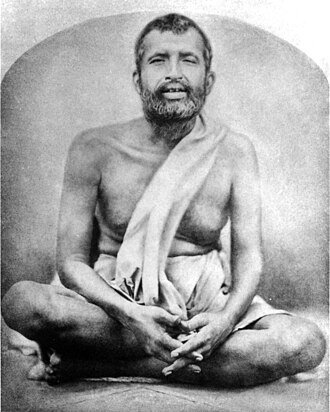
Ramakrishna
1836–1886 · Bengali mystic, priest of the Kali temple at Dakshineswar
Childhood and first visions
Gadadhar Chattopadhyay, whom his family called Ramakrishna, was born on 18 February 1836 in Kamarpukur, a village in the Hooghly district of Bengal. He came from a poor but deeply devout Brahmin family. His father, Khudiram, had lost his ancestral land after refusing to give false testimony, and his mother, Chandramani Devi, kept the household going through faith. According to his followers, his parents had visions before he was born, and the name Ramakrishna, linked to Rama, is said to have been given by his father, though this is disputed.
At around the age of six he described his first ecstasy. Walking between paddy fields, he saw a flock of white cranes against a dark storm cloud and lost all awareness of his surroundings. Similar experiences recurred in childhood, while he worshipped the goddess Vishalakshi or played the god Shiva in a Shivaratri festival. By ten or eleven such trances had become common, and in his last years they occurred almost daily.
Education
He attended the village school until the age of twelve. He learned to read and write in Bengali but disliked arithmetic and never progressed beyond the simplest operations. He then rejected formal schooling, which he saw as training for wage-earning, and instead absorbed the Ramayana, the Mahabharata and the Puranas by listening to wandering monks and to the kathaks, the reciters who sang these texts. Kamarpukur lay on a pilgrimage route to Puri, which brought him early contact with sadhus and holy men. He also had a gift for painting, acting and making images, and at fourteen he formed a theatre group with friends.
Priest at Dakshineswar
In 1852 he moved to Calcutta with his elder brother Ramkumar, who ran a Sanskrit school and worked as a priest. At that time the wealthy widow Rani Rasmani, admired for her management of her estates, her resistance to the British authorities and her generosity, had built a temple to the goddess Kali at Dakshineswar on the Hooghly. Because her family was considered low-caste by local Brahmins, the temple was formally given to a Brahmin so that worship could proceed. It was consecrated in May 1855, with Ramkumar as chief priest.
Ramakrishna at first objected to serving a deity his father would not have served, but he eventually accepted. After Ramkumar's death in 1856 he was made priest. According to his biographers, he performed humble tasks such as cleaning latrines to overcome caste pride. His nephew Hriday worked beside him for years.
The quest for the vision of Kali
At twenty, having witnessed several deaths in his family, he devoted himself with growing intensity to the worship of Kali. He sang with great feeling the songs of devotees such as Ramprasad and Kamalakanta, and during meditation in a nearby wood he would strip off his clothes and sacred thread, which alarmed Hriday. His longing became desperate: he ate and slept less and less, and asked the goddess whether she truly existed. In his own account, in a moment of anguish he seized a sword from the temple to end his life and then had a vision of the Mother that left him unconscious. From then on, it is said, he lived absorbed in the bliss of her presence, and seekers of every kind came to him.
Marriage and life with Sarada
Rumours that he had become unstable led his family to marry him in 1859 to Saradamani Mukhopadhyaya, then five, who later became known as Sarada Devi and is also regarded as a divine incarnation. Ramakrishna was twenty-three. The marriage was never consummated, since he had already embraced a life of renunciation. Sarada later joined him at Dakshineswar, and by tradition Ramakrishna revered her as the Divine Mother in person, which is why disciples knew her as the Holy Mother. She outlived him by thirty-four years and played a decisive part in the movement he had begun.
Spiritual paths: Tantra, Vaishnavism, Vedanta, Islam and Christianity
Ramakrishna practised a remarkable range of paths. Under the guidance of an ascetic, Bhairavi Brahmani, he worked through sixty-four tantric sadhanas between about 1861 and 1863, among them rituals of the left-hand path. He claimed not to have taken part directly in the sexual rites or the consumption of meat and wine, and he repeatedly warned his disciples against them. With the Vaishnava guru Jatadhari he worshipped Rama as a child, and later adopted the loving attitude of Radha towards Krishna, dressing as a woman for several days. Then the Vedanta monk Tota Puri initiated him into sannyasa in 1865, and after an experience of nirvikalpa samadhi that lasted, by his account, three days, Ramakrishna came to see in Kali the same power that Vedantists call Brahman. He also practised Islam and Christianity and claimed to have reached the Ultimate Reality through each. This conviction underpinned his view that all religions are paths to one goal.
Teaching, disciples and legacy
Ramakrishna taught through parables and everyday examples, and stressed direct experience of the divine over mere obedience to scripture. His reputation drew intellectuals, social leaders and ordinary people alike. Although he was at first reluctant to call himself a guru, he gathered disciples. The most prominent were the monks Vivekananda and Brahmananda, who after his death founded the Ramakrishna Order and the Ramakrishna Mission and carried his message to East and West. Ramakrishna died of throat cancer in Calcutta on 16 August 1886.
Key ideas
- The essential unity of religions: all religious traditions are different paths leading to the same goal.
- Direct experience of God: knowledge of the divine comes through personal experience and samadhi, rather than from merely observing the texts.
- Sincere devotion: an intense surrender to God, whatever path is chosen, is enough to reach the Ultimate Reality.
- Teaching through parables: his ideas were conveyed through simple stories, open to anyone regardless of caste or education.
Curiosities
A scene of cranes
He later described how a flock of cranes flying beneath dark storm clouds plunged him into such deep absorption that he lost awareness of his surroundings.
Dressed as a weaver woman
To prove that secluding women did not protect them, he disguised himself as a weaver woman, entered the inner rooms of a merchant who had challenged him, and won permission for the women to attend his recitals.
Teachers and influences
Pupils
- Swami Vivekananda 1863–1902
Original Filopedia text based on Wikipedia (es) and Wikipedia (en) and Wikidata.