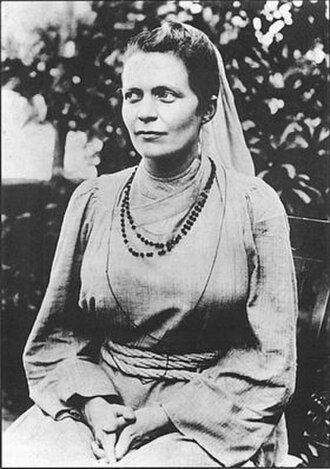
Sister Nivedita
1867–1911 · Irish educator and writer, disciple of Swami Vivekananda
Margaret Elizabeth Noble, known as Sister Nivedita, was an Irish-born educator, writer and social activist who spent much of her working life in India. She lived from 1867 to 1911, during the Victorian and Edwardian eras, and wrote in English. She matters because she built an unusual bridge between British culture and the Hindu reform movement, and because she championed the education of Indian girls at a time when few others did.
Born in Ireland, she grew up in a family with strong religious convictions and sympathy for Irish home rule. She worked as a teacher in several English and Welsh towns, became interested in the educational ideas of Pestalozzi and Froebel, and eventually ran her own school in London. After the death of her Welsh fiancé, she went through a long period of religious doubt that led her to search for truth elsewhere.
In 1895 she met Swami Vivekananda in London, and his teaching changed the course of her life. In 1898 she reached Calcutta, where he gave her the name Nivedita, meaning "Dedicated to God", and in November she opened a girls' school in the Bagbazar district. During the plague epidemic of 1899 she nursed poor patients. Her activism in support of Indian nationalism put her at odds with British authorities, and she had to publicly distance herself from the Ramakrishna Mission so as not to endanger it. She remained very close to Sarada Devi and to Vivekananda's fellow disciples.
Her writing mixes essays on Indian culture with accounts of her master's life and teaching. Her style is direct and instructive, and her main themes are education, Hindu religion and Indian nationalism.
She died in Darjeeling in October 1911. Her epitaph reads: "Here lies Sister Nivedita who gave her all to India." Her legacy lives on in girls' education in Bengal and in the memory of the early years of modern India.
Key works
- Kali the Mother (1900), an essay on the goddess Kali and the symbolism of the mother in Hindu religion.
- The Web of Indian Life (1904), a portrait of everyday life, religion and customs in India, written for Western readers.
- The Master as I Saw Him (1910), a personal memoir of Swami Vivekananda and his teaching.
Works in Filopedia
Curiosities
A name with meaning
Swami Vivekananda gave her the name Nivedita, meaning "Dedicated to God", when he initiated her into the vow of brahmacharya in March 1898.
A cut-short engagement
While teaching in Wrexham, in North Wales, she became engaged to a young Welshman, who died soon after the engagement.
Teachers and influences
Teachers
- Swami Vivekananda 1863–1902
Original Filopedia text based on Wikipedia (es) and Wikipedia (en) and Wikidata.