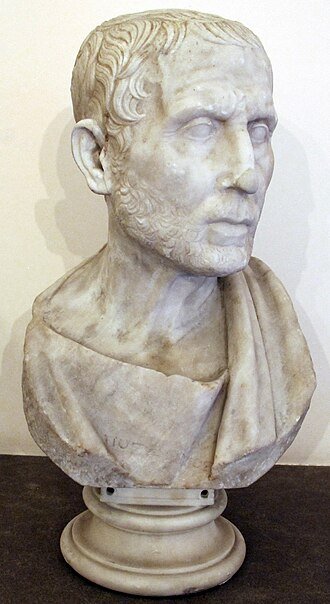
Posidonius
134 BC–50 BC · Stoic philosopher, astronomer and polymath from Apamea
Posidonius of Apamea (c. 135–51 BC) was a Greek Stoic philosopher who also worked as an astronomer, geographer, historian and politician. He was regarded as the most learned man of his age and, perhaps, of the whole Stoic school. His significance lies in how he carried Stoicism into the Roman world and opened it to other traditions, especially the thought of Plato and Aristotle.
He was born into a Greek family in Apamea, a Hellenistic city on the Orontes River in northern Syria. He studied in Athens under Panaetius of Rhodes, then the leading figure of the Stoic school. After Panaetius died around 110 BC, Posidonius did not stay in Athens. He settled on Rhodes, where he gained citizenship and ran a school that became the most important philosophical institution of the period. He took an active part in public life there and held the office of prytanis, one of the city's highest magistracies. Around 87–86 BC he was sent on an embassy to Rome, at a time when the Roman leaders Marius and Sulla were struggling for power. His ties with the Roman elite proved useful for his research.
Around the 90s BC he began a series of long journeys around the Mediterranean and beyond its frontiers. He travelled through Greece, Spain, Italy, Sicily, Dalmatia, Gaul, Liguria and North Africa, among other regions. At Gades, the modern Cádiz, he studied the tides and proposed that the daily tides were linked to the Moon's orbit, while monthly variations followed the lunar cycles. In Gaul he observed the Celts and left vivid accounts of them, although he saw their Druids as genuine philosophers.
His thought is organised around the idea that philosophy is the discipline that gives meaning to all other kinds of knowledge. As a Stoic, he divided philosophy into physics, logic and ethics, but treated them as inseparable parts of a single living whole: physics as flesh and blood, logic as bones and sinews, and ethics as the soul. In physics he defended a cosmic sympathy, a web of connections linking heaven and earth, which he believed made a kind of scientific prediction possible. In ethics he departed from the orthodox view of the early Stoics by holding that the passions belong to human nature, and that reason should govern them rather than eliminate them altogether.
His works are lost, and only fragments survive, though the titles and subjects of many are known. They covered meteorology, astronomy, geology, botany, history and ethnography. He tried to measure the distance and size of the Sun, and he built a planetary model which, according to Cicero, showed the motions of the Sun, the Moon and the five planets then known. His influence was considerable. His school on Rhodes drew students from Greece and Rome, and visitors included Pompey and Cicero. His grandson, Jason of Nysa, carried on the school. Through writers such as Cicero, Seneca and Strabo, his legacy reached the imperial age and left a mark on both the history of science and the history of Stoicism.
Key ideas
- Cosmic sympathy: the world is an organic whole in which every part is connected to the others, even across great distances.
- The passions as part of human nature: unlike orthodox Stoicism, he held that the passions are not merely mistaken judgements but natural impulses that reason must guide.
- Philosophy as a unifying discipline: physics, logic and ethics form one whole, like a living body in which ethics is the soul.
- Stoicism with an open mind: he drew on Plato and Aristotle while keeping to the Stoic doctrine of the Logos.
Curiosities
A distinguished audience
Cicero attended his lectures on Rhodes in 78 BC, and Pompey visited his school on two occasions.
A lesson on pain
According to the tradition, when he was elderly and suffering from gout, he pointed to his painful leg to argue that pain is troublesome but not an evil.
Teachers and influences
Teachers
- Panaetius 184 BC–110 BC
Pupils
- Athenodoros Cananites 100 BC–100 BC
Influenced by
- Panaetius 184 BC–110 BC
Original Filopedia text based on Wikipedia (es) and Wikipedia (en) and Wikidata.