Athenodoros Cananites
100 BC–100 BC · Stoic philosopher from Tarsus, pupil of Posidonius
Athenodorus Cananites, also called Athenodorus of Tarsus, was a Stoic philosopher born in Canana, near Tarsus, in present-day Turkey. Trained under Posidonius of Rhodes, he is remembered above all as a teacher and adviser to political figures during the transition from the Roman Republic to the Empire.
Around 44 BC he seems to have followed Octavian, the future Augustus, to Rome, where he is said to have rebuked the young man openly and ordered him to recite the alphabet before giving way to anger. Later he returned to Tarsus, where he helped remove the government of Boethus and drafted a new constitution that ended up favouring a pro-Roman oligarchy.
None of his writings survive. He is credited with a work against Aristotle's Categories, a history of Tarsus and treatises on zeal and education. He assisted Cicero with the De Officiis, and his work has been suggested as an influence on Seneca and Saint Paul. Strabo, Cicero and Eusebius held him in high regard.
Key ideas
- Opposition to Aristotle. He is credited with a work against Aristotle's Categories, though some attribute it to another Athenodorus.
- Learning and education. The titles of his lost works suggest an interest in zeal and instruction, but none of his texts have survived.
- Political counsel. His influence showed in public life, from shaping Octavian's education to drafting the constitution of Tarsus.
Curiosities
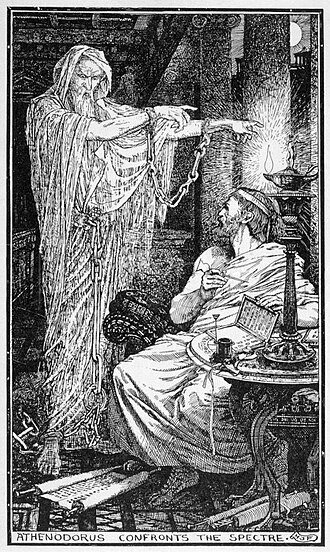
The haunted house in Athens
According to Pliny the Younger, Athenodorus rented a house in Athens that was unusually cheap. A chained ghost is said to have led him to a courtyard, where he found a skeleton that was then given a proper burial.
Teachers and influences
Teachers
- Posidonius 134 BC–50 BC
Original Filopedia text based on Wikipedia (es) and Wikipedia (en) and Wikidata.