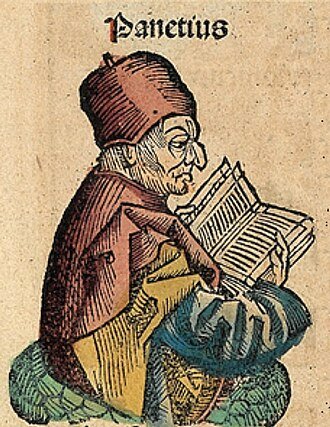
Panaetius
184 BC–110 BC · Greek Stoic philosopher from Rhodes
Panaetius of Rhodes was an ancient Greek philosopher of the Stoic school, and a leading figure of what is often called Middle Stoicism. Born on Rhodes around 185 BC and dying in Athens around 110 BC, he is remembered for carrying Stoic thought into the Roman world and for reshaping it into a more flexible, eclectic outlook.
He came from an established Rhodian family and was expected to pursue a diplomatic career, but he chose philosophy instead. He studied with Crates of Mallus at Pergamum and later with Diogenes of Babylon and Antipater of Tarsus in Athens, where he also heard Carneades. Around 144 BC he settled in Rome and joined the circle around Scipio Aemilianus, together with Polybius and Laelius. He taught there for years, and after Scipio's death in 129 BC he returned to Athens to lead the Stoic school.
His thought marked a clear shift. He gave up several traditional Stoic positions, such as the periodic destruction of the cosmos, the immortality of the soul and the reality of divination, and accepted the eternity of the world. He judged the Stoic ideal of total freedom from passion too demanding, and offered an ethics closer to ordinary life, built on living according to one's nature. In politics he held that the state arises from an agreement among people who wish to protect their property, and that slaves deserve justice. He admired the Roman republic for blending the best of monarchy, aristocracy and democracy, and he defended Roman rule as a means of bringing order to peoples living in tribal disorder, provided the conqueror aimed at the good of the conquered.
His main work, On Duties, has not survived, but it served as the model for Cicero's treatise of the same name. Through Cicero, much of his moral thinking reached later European tradition.
Key ideas
- Nature as moral guide: living in accordance with one's rational human nature is the standard of a virtuous life.
- The moderate sage: complete apatheia is unattainable, and certain emotions and pleasures can be in accordance with nature.
- Plurality of virtues: he rejected the strict unity of virtue and distinguished several kinds of particular virtues.
- State and contract: political community is natural and arises from an agreement among individuals seeking to protect their property.
- Just war: war belongs to animals rather than humans, yet it is admissible as a last resort to achieve peace and justice.
Curiosities
A refused honour
The Athenians offered him citizenship, but he declined it.
Travelling with Scipio
He accompanied Scipio Aemilianus on the Roman embassy to the monarchs and cities of the Hellenistic East in 139-138 BC.
Teachers and influences
Teachers
- Diogenes of Babylon 239 BC–149 BC
Pupils
- Posidonius 134 BC–50 BC
Influenced
- Posidonius 134 BC–50 BC
Original Filopedia text based on Wikipedia (es) and Wikipedia (en) and Wikidata.