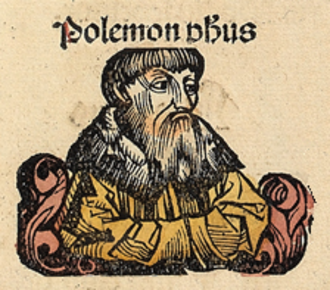
Polemon
400 BC–269 BC · Athenian Platonist philosopher, scholarch of the Academy
Polemon of Athens (c. 400 – 269 BC) was a Greek Platonist philosopher and the third successor of Plato as head of the Academy, a post he held from around 314 or 315 BC until his death. He belongs to the Academic tradition that carried Plato's teachings forward in the generations after him. His significance lies in insisting that philosophy had to be lived out in practice rather than kept as a purely theoretical study.
He was the son of Philostratus, a wealthy Athenian with political standing. In his youth he lived carelessly and extravagantly until, according to a story preserved by Diogenes Laertius, he burst into Xenocrates' school around the age of thirty at the head of a group of revellers. Xenocrates calmly went on discussing temperance, and Polemon, struck by his words, removed his garland and stayed to listen. From that day he adopted a modest and restrained way of life and kept attending the school. After Xenocrates' death he succeeded him as head of the Academy. His pupils and associates included Crantor of Soli, Crates of Athens, Arcesilaus, and, as a friend rather than a student, Zeno of Citium, the founder of Stoicism.
Polemon held that the purpose of philosophy was to train people in things and deeds rather than in dialectical speculation. He taught that the highest good lies in living according to nature, a view Cicero later recorded when summarising his position. He had a grave and severe temperament and took pride in the mastery he had gained over every kind of emotion. In literature he admired Homer and Sophocles, and he is said to have described Homer as an epic Sophocles and Sophocles as a tragic Homer. He wrote several treatises, but none survive intact, and his work is known only through scattered quotations. His influence lies mainly in giving Xenocrates' doctrine a sharper practical and ethical emphasis, and in serving as a link between the Old Academy and the later Hellenistic schools.
Key ideas
- Living according to nature: the highest good consists in living in accordance with the laws of nature.
- Philosophy as practice: wisdom must show itself in exercises concerning things and actions, rather than in dialectical speculation.
- Mastery of the passions: wisdom is measured by the control one exercises over one's emotions.
- Continuity with Xenocrates: he deepened his teacher's doctrines and gave them an ethical and practical emphasis.
Curiosities
The discarded garland
According to Diogenes Laertius, Polemon burst into Xenocrates' school drunk and wreathed in flowers. Listening to the talk on temperance, he removed the garland and stayed, and from then on lived a austere life.
Homer and Sophocles
He admired Homer and Sophocles and is said to have called Homer an epic Sophocles and Sophocles a tragic Homer.
Teachers and influences
Teachers
- Xenocrates 395 BC–313 BC
Pupils
- Crates of Athens 400 BC–260 BC
Original Filopedia text based on Wikipedia (es) and Wikipedia (en) and Wikidata.