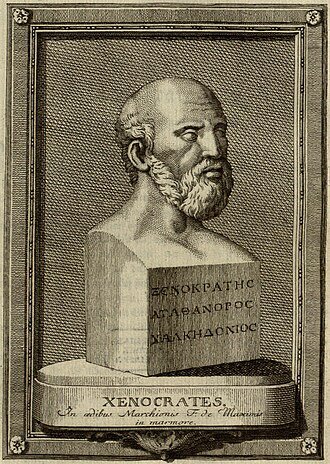
Xenocrates
395 BC–313 BC · Greek philosopher and mathematician, head of Plato's Academy
Xenocrates of Chalcedon (c. 396–314 BC) was a Greek philosopher and mathematician, a pupil of Plato who led the Platonic Academy from 339 to 314 BC. He belongs to what is called the Old Academy, the school that continued and systematised Plato's thought after the master's death. His significance lies in giving Platonism a more precise and ordered form, and in trying to join Plato's ideas with mathematics and Pythagorean speculation.
He was born in Chalcedon, on the Asian shore of the Bosphorus, and as a young man moved to Athens, where he studied with Aeschines Socraticus. He then attached himself to Plato and accompanied him to Sicily around 361 BC, when the philosopher visited the court of Dionysius of Syracuse. After Plato's death he visited Hermias of Atarneus together with Aristotle. In 339 or 338 BC he succeeded Speusippus as head of the Academy, winning the post by a narrow margin of votes over two rivals. He held the position until his death in Athens around 314 BC.
His output was large, though only fragments survive. He wrote treatises on knowledge, on the division of things into genera and species, on Ideas and on dialectic, along with works on physics, ethics and mathematics. He had a taste for threefold schemes: he divided philosophy into physics, ethics and logic, and distinguished three grades of cognition, namely knowledge, tied to the world of pure forms; sense perception, tied to the world of appearances; and opinion, which lies between the two and rests on perception together with mathematical reasoning. In metaphysics he regarded unity and duality as divine principles, and described the world-soul as a number that moves itself. His most distinctive move was to identify the Platonic Forms with numbers, an attempt to reconcile Plato's idealism with the Pythagorean inheritance. In ethics he held that virtue produces happiness, though external goods can help it along.
His influence was felt in the later Academy, where his successor Polemon and others carried forward his systematic presentation of Platonism. Much of what we know of his thought comes from later writers such as Plutarch and Sextus Empiricus, which makes precise reconstruction difficult.
Key ideas
- Threefold division of philosophy: philosophy is organised into physics, ethics and logic.
- Three grades of cognition: knowledge, sense perception and opinion, each tied to a different domain of reality.
- Forms as numbers: Platonic Forms are understood as numerical realities, in line with the Pythagorean tradition.
- The soul as a self-moving number: the world-soul is described as a number that moves itself.
- Virtue and happiness: virtue alone produces happiness, though external goods can help to reach it.
Curiosities
A citizenship declined
It is said that he turned down Athenian citizenship offered by Phocion, arguing that he did not wish to belong to a constitution he had fought to prevent.
An accidental death
According to the sources, he died after striking his head when he tripped over a bronze pot in his house.
Teachers and influences
Teachers
- Plato 428 BC–348 BC
Pupils
- Polemon 400 BC–269 BC
Original Filopedia text based on Wikipedia (es) and Wikipedia (en) and Wikidata.