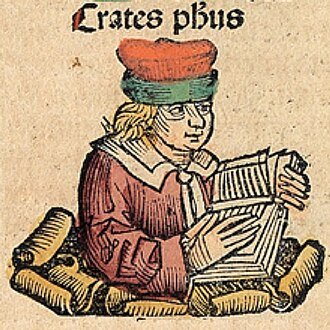
Crates of Athens
400 BC–260 BC · Platonist philosopher of Athens, scholarch of the Academy
Crates of Athens was a Platonist philosopher of ancient Athens, born in the Thriasian deme and son of Antigenes. He matters chiefly as the last scholarch of the Old Academy and as the link between Polemo and Arcesilaus, whose tenure opened the sceptical phase of the Academy.
He was the pupil and close companion of Polemo, whom he succeeded as head of the Academy around 270–269 BC. Their friendship was famous in antiquity: Diogenes Laertius preserves an epigram by the poet Antagoras claiming that the two were buried in one tomb. His most notable students were Arcesilaus, who later led the school, Bion of Borysthenes and Theodorus the Atheist.
None of his writings survive. Ancient reports describe works on philosophy and comedy, and possibly speeches, though the latter are probably by another Crates, of Tralles. He is also tentatively identified with the Crates whom Plutarch describes as an Athenian envoy who persuaded Demetrius Poliorcetes to lift the siege of Athens.
His influence is felt mainly through Arcesilaus, whose turn toward suspended judgment shaped the later history of the Academy.
Key ideas
- Platonic continuity: Crates kept the Academy's teaching in the line of his predecessor Polemo, without leaving a surviving doctrine of his own.
- Friendship as philosophical practice: His close bond with Polemo, extending even beyond death, reflects the Academy's value on shared life and moral example.
- Transmission of the school: His main role was to educate and hand over the leadership of the Academy, which made Arcesilaus's later development possible.
Curiosities
A shared tomb
According to an epigram by Antagoras preserved by Diogenes Laertius, Crates and Polemo were buried together in one tomb.
A possible envoy
Plutarch describes a Crates sent by Athens who persuaded Demetrius Poliorcetes to lift the siege, though it is not certain that this was the philosopher.
Teachers and influences
Teachers
- Polemon 400 BC–269 BC
Pupils
- Arcesilaus 314 BC–239 BC
Original Filopedia text based on Wikipedia (es) and Wikipedia (en) and Wikidata.