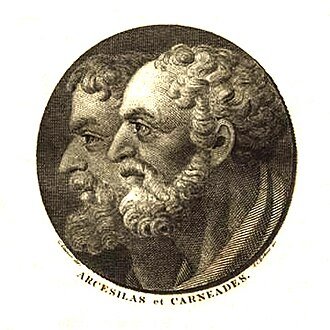
Arcesilaus
314 BC–239 BC · Greek philosopher, skeptic and head of Plato's Academy
Arcesilaus was a Greek philosopher who lived from about 315 to about 240 BC and led Plato's Academy in Athens. His importance lies in steering Platonism toward skepticism: he is regarded as the founder of what is called the Middle or New Academy, the phase in which Plato's school adopted philosophical doubt as its method.
From Pitane in Aeolis, he first studied rhetoric in Athens and then followed the teaching of Theophrastus, Crantor, Polemo and Crates, becoming head of the Academy after Crates. Later sources also connect him with Timon of Phlius, a disciple of Pyrrho, whose ideas may have shaped his critical turn.
Arcesilaus committed nothing to writing, so his thought survives mainly through his opponents, above all the Stoics led by Zeno of Citium. His chief target was the 'cognitive impression' that the Stoics believed guaranteed secure knowledge. Arcesilaus argued that we cannot reliably tell a true impression from a false one, since dreams, errors of the senses and madness can produce equally vivid impressions. He therefore recommended suspending judgement, the epoche. His doubt, however, did not extend to conduct: he accepted reasonable opinions as a practical guide, which set him apart from the Pyrrhonists, whose goal was ataraxia.
His influence was considerable. Carneades and later Academics continued his critical line, and Academic skepticism became one of the most influential currents of the Hellenistic age. His method, based on dialogue and the refutation of others' claims, revived the Socratic spirit of the old Academy.
Key ideas
- Suspension of judgement (epoche): one should not affirm anything that cannot be held with certainty.
- Critique of Stoic apprehension: there is no infallible criterion for telling a true impression from a false one.
- Doubt without practical despair: reason can be guided by probable opinions without ever reaching certainty.
Curiosities
A saying about his teachers
Aristo of Chios joked that Arcesilaus had Plato as his head, Pyrrho as his tail and Diodorus in the middle, meaning that he presented himself as a Platonist while his substance was Pyrrhonist.
Unusual wealth
Arcesilaus was wealthy at a time when most philosophers were poor, and he is said to have been very generous with his friends.
Defended by a Stoic
When Arcesilaus was accused of neglecting his duties, the Stoic Cleanthes replied that although he did not speak of duty, he recommended it through his actions.
Teachers and influences
Teachers
- Crates of Athens 400 BC–260 BC
Pupils
- Eratosthenes 275 BC–193 BC
- Chrysippus of Soli 280 BC–207 BC
Original Filopedia text based on Wikipedia (es) and Wikipedia (en) and Wikidata.