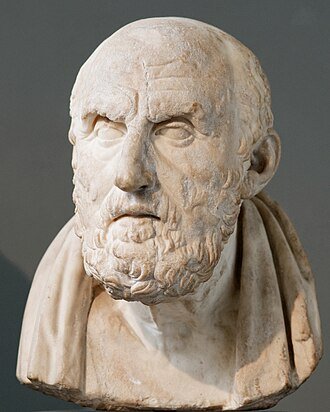
Chrysippus of Soli
280 BC–207 BC · Greek Stoic philosopher, the so-called second founder of Stoicism
Chrysippus of Soli (c. 281/78 – c. 208/05 BC) was a Greek philosopher and the most important figure of ancient Stoicism. Born in Cilicia, he moved to Athens as a young man and studied under Cleanthes. His significance lies in giving Stoicism the systematic form that made it endure. For this reason he is regarded as the school's second founder, and in antiquity it was said that without him there would have been no Stoa.
He was said to be the son of a man named Apollonius of Tarsus, though he is believed to have been born in Soli. He was reportedly small in stature and trained as a long-distance runner. While still young, he lost his inherited property, which was seized by the royal treasury. In Athens, besides Cleanthes, he is said to have attended lectures by Arcesilaus and his successor Lacydes at Plato's Academy, which gave him first-hand familiarity with the arguments against Stoic doctrine. When Cleanthes died around 230 BC, he took over the leadership of the school. He died at the age of 73, during the 143rd Olympiad (208–204 BC). Diogenes Laertius records two accounts of his death: in one, he collapsed with dizziness after drinking undiluted wine at a feast; in the other, he died laughing after watching a donkey eat figs and urging that it be given pure wine to go with them.
His work covered logic, epistemology, ethics and physics. He gave a precise definition of the proposition and classified propositions as simple or compound, building a system of propositional logic around connectives such as conjunction, disjunction and the conditional. He understood a conditional as true when denying its consequent is incompatible with its antecedent. In physics, he held that the universe is governed by a divine reason. Although he leaned toward a fatalist view of destiny, he sought a place for personal agency, expressed in how we assent to what happens. In ethics, he believed that right conduct depends on understanding the nature of the universe, and he advocated uprooting the unruly passions that depress and crush the soul.
He was an extremely prolific writer, credited with more than 705 works, and it was said he rarely went to sleep without having written five hundred lines. His critics accused him of filling his books with the words of others, and his style was considered diffuse and obscure. None of his works survives complete; what remains are fragments quoted by Cicero, Seneca, Galen and Plutarch, along with some passages found among the Herculaneum papyri.
His influence was decisive. Thanks to him, Stoicism became one of the most influential philosophical movements in the Greek and Roman world for centuries. His linguistic and logical orientation made his work hard going even for members of the school. He is also often regarded as the founder of grammar as a distinct discipline in Greece. He was succeeded as head of the Stoa by his pupil Zeno of Tarsus.
Key ideas
- Propositional logic. It studies the relations between whole statements, such as “it is day” or “it is raining”, rather than only between terms, greatly extending the logic inherited from Aristotle.
- Fate and freedom. The world is ordered by a rational necessity that determines what happens, yet the individual keeps a margin of action in how he assents to events and acts upon them.
- Ethics as therapy. Understanding the nature of the universe is the basis for living well, and the aim is to free oneself from the turbulent passions that weigh down the soul.
- Divine reason. The reason (logos) that governs the cosmos is also present in human beings, so the study of logic has a practical purpose in guiding life.
Curiosities
The remark about the principles
He is said to have told Cleanthes that he only needed the principles, since he would find the proofs himself. It reflects the self-confidence his contemporaries noted in him.
A death in laughter
According to one of the accounts given by Diogenes Laertius, he died laughing after watching a donkey eat figs and asking for pure wine to be given to it with them.
Five hundred lines a day
It is said that he rarely went to bed without having written five hundred lines, and more than seven hundred works are credited to him.
Teachers and influences
Teachers
- Cleanthes 330 BC–231 BC
- Arcesilaus 314 BC–239 BC
Pupils
- Diogenes of Babylon 239 BC–149 BC
- Zeno of Tarsus 250 BC–200 BC
Influenced by
- Cleanthes 330 BC–231 BC
Original Filopedia text based on Wikipedia (es) and Wikipedia (en) and Wikidata.