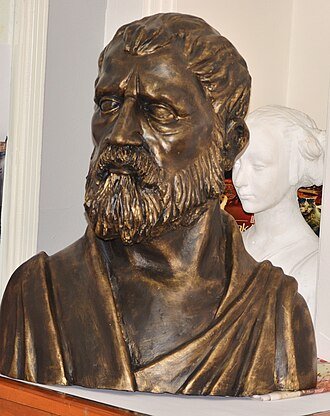
Zeno of Tarsus
250 BC–200 BC · Stoic philosopher from Greece
Zeno of Tarsus was a Greek philosopher of the Stoic school, active around 200 BC. He belongs to the Hellenistic tradition, in which Stoicism took shape in Athens as a doctrine about reason, nature and virtuous conduct. His importance lies in keeping the school going after the death of his teacher.
He studied under Chrysippus of Soli, the central figure of Stoicism, and succeeded him as head of the school in Athens. According to Diogenes Laertius he wrote very few books, yet he left a large number of disciples. Philodemus reports that he answered the views of the Peripatetic Hieronymus of Rhodes in five books. Little is known of his own philosophy. He seems to have been an orthodox Stoic in most respects, but he doubted the conflagration that was supposed to consume the universe periodically in fire, a notable change to Stoic physics. The date of his death is unknown, and Diogenes of Babylon succeeded him.
What we know of him comes mostly from the testimony of other authors, which shows his role as a link between Chrysippus and the later generations of Stoics.
Key ideas
- The rational order of the cosmos: the universe is governed by a rational principle that shows itself in nature.
- The periodic conflagration: the doctrine that the world dissolves into fire and is formed again, which Zeno questioned.
- Virtue as living in accordance with nature: the good consists in living according to reason, which human beings share with the order of the cosmos.
- The continuity of the school: the transmission of Stoicism after Chrysippus, with many disciples trained under it.
Curiosities
Few books, many disciples
According to Diogenes Laertius, Zeno wrote very few books but left a great number of disciples.
A refutation in five books
Philodemus reports that Zeno answered Hieronymus of Rhodes, a Peripatetic philosopher, in five books titled Against Hieronymus.
Teachers and influences
Teachers
- Chrysippus of Soli 280 BC–207 BC
Pupils
- Diogenes of Babylon 239 BC–149 BC
Original Filopedia text based on Wikipedia (es) and Wikipedia (en) and Wikidata.