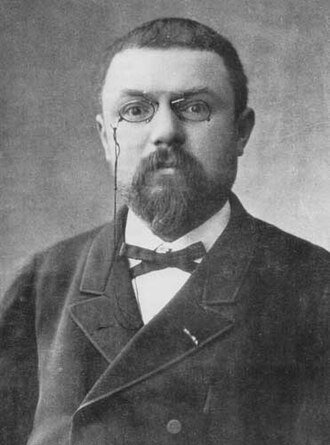
Henri Poincaré
1854–1912 · French mathematician, theoretical physicist and philosopher of science
Childhood and family
Jules Henri Poincaré was born on 29 April 1854 in the Cité Ducale district of Nancy, into an influential family. His father, Léon Poincaré, was a professor of medicine at the University of Nancy, and his mother, Eugénie Launois, a woman of great intellect who supervised his education when a bout of diphtheria kept him away from school for a time. His younger sister, Aline, married the spiritualist philosopher Émile Boutroux. His cousin Raymond Poincaré would later serve as President of France from 1913 to 1920.
Education
In 1862 he entered the lycée in Nancy, which now bears his name. He excelled in almost every subject, especially in written composition and mathematics, where his teacher called him "a monster of mathematics". He won prizes in the concours général, a competition among the best pupils in French lycées. His weakest subjects were music and physical education, where he was described as average at best. He graduated in 1871 and during the Franco-Prussian War of 1870 served alongside his father in an ambulance corps.
In 1873 he entered the École Polytechnique, where he studied under Charles Hermite and published his first scientific paper in 1874. He then moved to the École des Mines, combining mining engineering with mathematics, and qualified as an engineer in 1879. That same year he received his doctorate from the University of Paris with a thesis on differential equations. In it he studied, for the first time, the geometric properties of such equations, and recognised that they could describe the motion of several bodies in the solar system.
Early career
As a mining engineer he inspected the Vesoul region and, in August 1879, led the official investigation into the Magny disaster, in which eighteen miners died. Shortly afterwards he became a lecturer at the University of Caen, where he met Louise Poulain d'Andecy, whom he married in 1881; they had four children. That year he also began teaching at the Sorbonne, where he remained for the rest of his life, first in analysis and later in mechanics, mathematical physics, probability and astronomy. From 1881 to 1885 he also worked as an engineer on the development of the railway network in northern France, and eventually rose to become inspector general of the Corps des Mines.
In 1881 and 1882 he created a new branch of mathematics, the qualitative theory of differential equations, which extracts information about the behaviour of solutions without solving the equation itself. He applied this approach to celestial mechanics and mathematical physics. In 1896, while examining the X-rays recently discovered by Röntgen, he suggested that their emission might be linked to fluorescence, an idea that inspired Henri Becquerel's experiments leading to the discovery of radioactivity.
The three-body problem
In 1887, to mark the sixtieth birthday of King Oscar II of Sweden and Norway, a mathematical competition was announced on the stability of the solar system. Poincaré concentrated on the three-body problem, which was too difficult in its general form, and submitted an essay so remarkable that the jury awarded him the prize. Karl Weierstrass, one of the judges, said that although it did not fully solve the question, its importance would inaugurate a new era in celestial mechanics.
The first version contained a serious error, which Poincaré discovered while checking the proofs. Correcting it led him to doubly asymptotic orbits, now regarded as the origin of chaos theory. He showed that tiny differences in the initial state of a system can eventually lead to radically different outcomes, so long-term prediction may be impossible. The corrected memoir was published in 1890, and the cost of withdrawing the first edition exceeded the value of the prize.
Relativity and other work in physics
In 1893 he joined the Bureau des Longitudes, where he worked on synchronising time around the world. This led him to consider how clocks moving at different speeds could be synchronised. He interpreted Hendrik Lorentz's electromagnetic theory in terms of the principle of relativity, according to which no mechanical or electromagnetic experiment can distinguish uniform motion from rest. In 1900 he analysed Lorentz's "local time", and in 1904 he stated the principle of relativity clearly. In 1905 he wrote to Lorentz to correct an error in the application of his transformations and gave the relativistic law for adding velocities. That same year he published work that helped complete the foundations of special relativity, and he proposed gravitational waves propagating at the speed of light.
Poincaré retained the concept of the ether and did not abandon it in his writings after 1905, so his interpretation differed from Einstein's, although his mathematical results were largely equivalent. Einstein did not cite him in his first paper on relativity. Later he acknowledged Poincaré as one of the precursors of Lorentz's theory, without explicitly crediting him with a central role in special relativity. In his final years Poincaré worked on a theory of gravitation that in some respects anticipated general relativity, and which David Hilbert later developed further.
Character and working habits
Poincaré studied his own way of thinking and, in 1908, presented his observations to the Institute of General Psychology in Paris. He worked in short, regular sessions and spent about four hours a day on mathematical research. He usually solved problems entirely in his head before writing them down, and believed that his subconscious kept working on one question while he attended to another. Édouard Toulouse recorded these observations in his 1910 book, noting that Poincaré started from basic principles rather than from established frameworks. He regarded logic as a tool for ordering ideas rather than generating them, and held that intuition drives mathematics.
Reception and legacy
He was the most admired mathematician of his time and the only member elected to every section of the French Academy of Sciences. He presided over the Academy in 1906 and entered the Académie française in 1908. His contributions span algebraic topology, to which he gave its foundations, the theory of functions, algebraic geometry, number theory and mathematical physics. The conjecture he formulated in 1904 was solved by Grigori Perelman, who received the Millennium Prize for it. He also wrote popular works such as Science and Hypothesis, in which he defended the role of convention in science.
In 1912 he underwent surgery for a prostate complication and died of an embolism in Paris on 17 July that year, aged 58. He is buried in the family vault in the Montparnasse Cemetery. He never received the Nobel Prize in Physics, although he was nominated many times; the committee tended to regard his work as theory rather than experimental results.
Key ideas
- Qualitative geometry of differential equations: studying the overall shape of solutions without calculating each one.
- Deterministic chaos: in dynamical systems, tiny differences in initial conditions can produce very different outcomes, limiting prediction.
- Conventionalism: some scientific principles are conventions chosen for their usefulness rather than truths forced on us by experience.
- Relativity: no mechanical or electromagnetic experiment can distinguish uniform motion from rest.
- Algebraic topology: using algebraic invariants, such as the fundamental group, to classify geometric spaces.
Where to start
Science and Hypothesis is a popular essay, written for non-specialist readers, in which Poincaré reflects on the scientific method through mathematics, space, physics and nature. It offers an accessible entry into his philosophical ideas about science without requiring prior technical knowledge.
Next: The Value of Science. It continues the questions of the earlier work and expands his reflection on the value and scope of scientific knowledge, making it a natural next step after the first reading.
Works in Filopedia
Books to read
- The Foundations of Science: Science and Hypothesis, The Value of Science, Science and Method EnglishEPUB 519 KBRead online
- Science and hypothesis EnglishGutenberg
Curiosities
A prize that did not cover his costs
Correcting his prize-winning memoir after an error was spotted before publication obliged him to pay for withdrawing the printed issue, and the prize money did not cover the expense.
A suggestion that inspired Becquerel
In 1896, during a lecture on X-rays, he proposed that their emission might be a side effect of fluorescence, an idea that inspired Henri Becquerel's experiments leading to the discovery of radioactivity.
Original Filopedia text based on Wikipedia (es) and Wikipedia (en) and Wikidata.