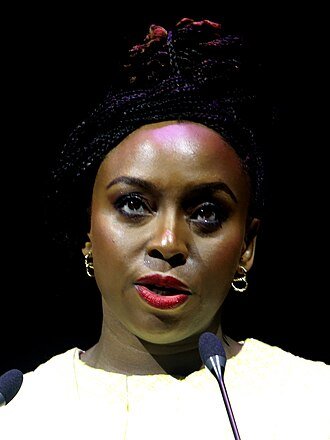
Chimamanda Ngozi Adichie
b. 1977 · Nigerian novelist and essayist
Chimamanda Ngozi Adichie (born in Abba, Enugu, in 1977) is a Nigerian novelist, essayist and short-story writer from an Igbo family. She is widely regarded as a central figure in postcolonial and feminist literature, and her work has reached readers around the world.
She grew up in Nsukka, where her father taught at the University of Nigeria, in a house once occupied by Chinua Achebe. As a child she read mainly English-language stories, especially by Enid Blyton, and she came to African literature only at about ten. She spent a year and a half studying medicine and pharmacy in Nsukka before leaving for the United States at nineteen to study communications and political science at Drexel and Eastern Connecticut State University. She later earned a master's degree in creative writing at Johns Hopkins and another in African studies at Yale, completed in 2008. Before her first novel she had already published a poetry collection, Decisions (1997), and a play about the Biafran war.
Her debut novel, Purple Hibiscus, appeared in 2003 after a slow search for a publisher; several editors asked her to move the story from Africa to America. A small house finally took it on. Set in a Nigerian family shaped by religion and a strict father, it was shortlisted for the Booker Prize. Half of a Yellow Sun (2006) reconstructs the Biafran war through several characters and brought her international recognition. Americanah (2013), which follows a young Nigerian woman who emigrates to the United States, looks at race, identity and stereotypes about Africa from a position that moves between Nigeria and the West.
Her public voice has also grown through essays and lectures. Her TED talk The Danger of a Single Story (2009) and the essay We Should All Be Feminists (2014), based on a 2012 talk, reached very wide audiences. Her legacy joins fiction with reflection on gender, culture and representation, and her influence can be seen in global feminist debate and in the push for more varied images of Africa.
Key works
- Purple Hibiscus (2003): her first novel, about a Nigerian family shaped by religion and paternal authority.
- Half of a Yellow Sun (2006): a novel about the Biafran war seen through several characters.
- Americanah (2013): a novel about a Nigerian immigrant and questions of race and identity in the United States.
- We Should All Be Feminists (2014): a short essay on gender and equality, drawn from a TED talk.
Where to start
Purple Hibiscus 2003
Purple Hibiscus is Adichie's first novel and an accessible gateway to her world. Narrated by a teenager in postcolonial Nigeria, it portrays family life, religion, domestic violence and the political instability of the country with sensitivity, presenting the author's central themes through an intimate and highly readable story.
Next: Americanah. Americanah broadens her gaze to migration, race and identity, following a young Nigerian woman between Lagos and the United States with humor and sharp insight.
Works in Filopedia
- Purple Hibiscus 2003
- Half of a Yellow Sun 2006
- Americanah 2013
Curiosities
A change of name
At her Catholic confirmation she changed her English name from Grace to Amanda, and her first work was published under that name.
An essay in Swedish classrooms
According to her sources, We Should All Be Feminists was distributed in Swedish schools as compulsory reading for students.
A novel turned into television
Americanah was adapted as a television series, with Lupita Nyong'o as producer and lead actress.
Teachers and influences
Influenced by
- V. S. Naipaul 1932–2018
- Chinua Achebe 1930–2013
- Enid Blyton 1897–1968
Original Filopedia text based on Wikipedia (es) and Wikipedia (en) and Wikidata.