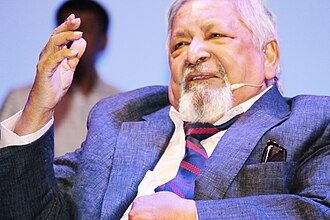
V. S. Naipaul
1932–2018 · British writer born in Trinidad, Nobel Prize in Literature in 2001
Childhood and roots
Vidiadhar Surajprasad Naipaul, known as V. S. Naipaul, was born on 17 August 1932 in Chaguanas, a sugar town on the island of Trinidad, in the British crown colony of Trinidad and Tobago. He was the son of Droapatie Capildeo and Seepersad Naipaul, and the couple's second child and first son. His grandparents had come from northern India in the late nineteenth century as indentured labourers on sugar plantations. According to the genealogy the family reconstructed in Trinidad, they were Brahmins, though his father's background remained less certain. Over time the ritual restrictions of their ancestors loosened: chicken and fish appeared at the family table, Christmas was celebrated with a dinner, and the men wore only Western clothes. The languages of India also gradually disappeared from the home.
A journalist father
Seepersad Naipaul was an English-language journalist with a deep reverence for writers and the literary life, an enthusiasm he passed on to his eldest son. He began contributing stories to the Trinidad Guardian in 1929 and in 1932 joined its staff as the provincial correspondent for Chaguanas. When the young Vidia was seven the family moved to the capital, Port of Spain, and later settled there permanently. Naipaul would later describe in his autobiography how his father's aspirations shaped his own dreams.
Education in Trinidad and Oxford
Naipaul enrolled at Queen's Royal College, a government-run school in Port of Spain modelled on a British boys' public school. Before turning seventeen he won a Trinidad government scholarship to study abroad. He later recalled that it could have funded any subject at any institution in the Commonwealth, but he chose Oxford to read English, with the aim of becoming a writer. In August 1950 he boarded a Pan Am flight to New York and continued by boat to London. His notes and letters from that journey later became the basis for a chapter of his novel The Enigma of Arrival, written thirty-seven years afterwards.
At Oxford he initially felt adequately prepared, but by 1951 his attempts at writing seemed contrived to him, and loneliness and uncertainty brought on depression. In April 1952, after an impulsive trip to Spain that exhausted his savings, he described the episode as a nervous breakdown, and decades later as something like a mental illness. That same year he met Patricia Ann Hale, a history student, who became his support and, gradually, the partner who helped plan his career. Both graduated in June 1953 with modest results. Naipaul, however, earned praise from J. R. R. Tolkien, the Anglo-Saxon professor, who judged his paper the best in the university.
Grief and hardship in London
In 1953 his father died, and by Hindu custom it fell to the eldest son to light the funeral pyre. Naipaul could not return for lack of time and money, so his eight-year-old brother Shiva performed the cremation rites. Naipaul wrote that the event marked his brother deeply. Through 1953 and 1954 the writer lived with little money in post-war Britain, depending on Pat and his family, and reluctantly enrolled in a postgraduate course in English Literature at Oxford, which he abandoned after failing the viva voce in February 1954.
Caribbean Voices and marriage
In December 1954 Henry Swanzy, producer of the BBC's weekly programme Caribbean Voices, offered him a renewable three-month contract as presenter. The programme had launched a generation of Caribbean writers, among them George Lamming, Samuel Selvon and Derek Walcott. Naipaul stayed for four years, though during that time Pat remained the couple's chief earner. In January 1955 they married in a ceremony with only the two legally required witnesses, and neither told their families. Naipaul would later say that the marriage was in many respects unhappy, and that they lived together for forty-one years, until her death from cancer in 1996.
The first Trinidad books
In the summer of 1955, in the freelancers' room of the old Langham Hotel, Naipaul typed out in about five weeks Miguel Street, a set of linked stories about a street in Port of Spain, drawn from the memory of a childhood neighbour. Diana Athill, an editor at André Deutsch, liked it, but the publisher doubted that a collection by an unknown Caribbean author would sell in Britain and asked for a novel instead. Naipaul quickly wrote The Mystic Masseur, a satire on the social climbing of a man from the rural Hindu world of Trinidad. It was published in June 1957 to generally favourable reviews. Next came The Suffrage of Elvira, about a rural election in the island, and in 1961 A House for Mr Biswas, considered his great early novel. Its protagonist is modelled on his father's life, and the author himself said the book had in some respects "destroyed memory". Patrick French has called it universal in the way Dickens or Tolstoy is, for revealing a complete world without apology or exoticism.
Travel, essays and the view of India
After tensions with the BBC, which ended in his departure in 1958, Naipaul turned more to criticism and journalism. In 1961 he published The Middle Passage, his first travel book, on the West Indies, British Guiana, Suriname, Martinique and Jamaica, which exposed poverty, racism and cultural alienation in those societies. In 1962 he travelled with Pat to India, the land of his ancestors, and the result was An Area of Darkness (1964), a book that expresses his frustration with Indian resignation in the face of poverty and offers a critical reading of Gandhi. That book and his novel The Mimic Men (1967), about a kind of "colonial schizophrenia", established his reputation as a relentless observer of postcolonial worlds.
Key works
- The Mystic Masseur (1957): a satire on the social rise of a rural healer in Trinidad, his first novel.
- A House for Mr Biswas (1961): the story of a man struggling to own a home of his own, his most celebrated book.
- In a Free State (1971): the novel with which he won the Booker Prize.
- A Bend in the River (1979): a novel about a merchant of Indian descent settled in an unnamed African country in the middle of political disorder.
Where to start
A House for Mr Biswas is the novel that brought Naipaul his first international recognition. It follows Mohun Biswas, a man of Indian descent in colonial Trinidad, in his struggle to own a home of his own. It is an accessible and warm book, offering the humour, humanity and critical eye that define the author.
Next: A Bend in the River. A Bend in the River, also acclaimed, widens his gaze to violence and displacement in the postcolonial world of Africa.
Works in Filopedia
- The Mystic Masseur 1957
- A House for Mr Biswas 1961
- In a Free State 1971
- A Bend in the River 1979
- The Enigma of Arrival 1987
Curiosities
A rite left to his brother
When their father died in 1953, Hindu custom assigned the eldest son the duty of lighting the funeral pyre, but Naipaul had neither the time nor the money to return to Trinidad. His eight-year-old brother, Shiva, performed the cremation rites instead.
Praise at Oxford
During his studies at Oxford, J. R. R. Tolkien judged Naipaul's Anglo-Saxon paper to be the best in the university, though Naipaul did not go on to continue his academic work there.
Teachers and influences
Influenced
- Chimamanda Ngozi Adichie b. 1977
Original Filopedia text based on Wikipedia (es) and Wikipedia (en) and Wikidata.