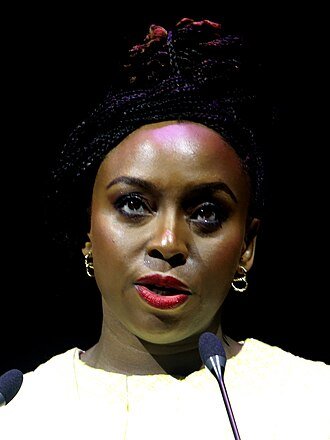
 AuthorChimamanda Ngozi Adichieb. 1977
Half of a Yellow Sun is a 2006 novel by the Nigerian writer Chimamanda Ngozi Adichie. It was first published in London by 4th Estate, an imprint of HarperCollins, and in the United States by Knopf. It is Adichie's second novel, after Purple Hibiscus (2003). She wrote it over roughly three years and took its title from an emblem on the Biafran flag. Although she was born seven years after the Nigerian Civil War, she conceived the book as a way of understanding the memory of her own family, which lost grandparents during the conflict.
The story is set in Nigeria in the 1960s, before and during the Biafran War (1967-1970). It follows three main characters: Ugwu, a thirteen-year-old village boy who becomes a houseboy for Odenigbo, a radical mathematics professor at the University of Nsukka; Olanna, Odenigbo's partner, the daughter of a wealthy businessman, who has given up a life of privilege in Lagos to be with him; and Richard, an English writer who becomes involved with Kainene, Olanna's twin, who runs her father's company. Odenigbo's house becomes a gathering place for intellectuals debating Africa's political future. When ethnic massacres between Hausa and Igbo people escalate and the southeast secedes to form the Republic of Biafra, the characters are forced to flee and end up in the refugee town of Umuahia, where they face hunger, air raids and a climate of constant suspicion.
The novel does not follow a chronological order. It is divided into four parts that alternate between the early and late 1960s, allowing the reader to learn about personal conflicts that predate the war, such as Odenigbo's infidelity and Olanna's response to it. Its focus is less on international politics than on the fate of particular people, and Ugwu's development from a naive boy into a chronicler of the Biafran experience has often been read as a bildungsroman. Its central theme is the trauma left by war, presented as a structural wound running through society and families rather than as a closed historical episode.
The book belongs to postcolonial reflection. Odenigbo argues that the only authentic African identity is tribal and that Nigeria was an invention of the colonial powers; other characters defend Pan-Africanism. Richard, whose figure was partly inspired by the writer Frederick Forsyth, embodies the fascination and ambiguity of an outsider who identifies with Biafra more fiercely than the Biafrans themselves, and his failure to write the story he wants to tell raises the question of who has the right to narrate Africa. Adichie has said the character is a subtle way of suggesting that Africans should be the ones writing about Africa.
The novel received largely positive reviews, praised for its characters and its portrayal of the war, although some critics noted that the voices of the three protagonists are hard to tell apart. In 2007 it won the Women's Prize for Fiction, worth £30,000. It has appeared on lists of the most notable books of its year and of the most important novels of the early twenty-first century, and in 2020 it was voted the best book to have won that prize in its first twenty-five years. A film adaptation, written by Biyi Bandele and starring Chiwetel Ejiofor and Thandiwe Newton, premiered in 2014.
Themes
Other works by Chimamanda Ngozi Adichie
- Purple Hibiscus 2003
- Americanah 2013
Original Filopedia text based on Wikipedia (es) and Wikipedia (en) and Wikidata.