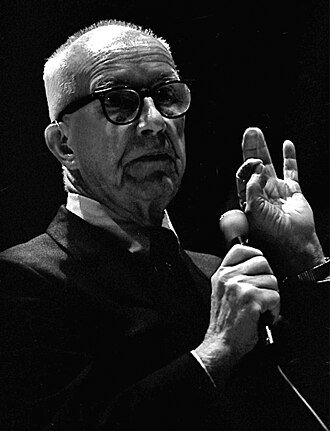
Buckminster Fuller
1895–1983 · American designer, architect and inventor, thinker on sustainability
Richard Buckminster Fuller (1895-1983) was an American designer, architect, inventor and writer, best known for the geodesic dome and for his argument that humanity could live well by using the planet's resources far more efficiently. He worked in the first half of the twentieth century and into the postwar decades, when technology was beginning to raise serious questions about the survival of the species. That is why he still matters: he combined engineering, geometry and a global view of the Earth as a finite system.
He was born in Milton, Massachusetts, into a prosperous family. He spent much of his youth on Bear Island, off the coast of Maine, where he learned to make things from materials he found in the woods. He studied at Harvard, from which he was expelled twice, and then worked as a mechanic and in the meatpacking industry. After the First World War he developed, with his stepfather, the Stockade Building System for lightweight housing, a venture that failed commercially. In 1927 he went through a deep personal crisis after the death of his daughter Alexandra and the collapse of his business. By his own account, on the shore of Lake Michigan he decided not to end his life and to devote himself to an experiment: finding out what one person could contribute to improving the world.
From then on he became a tireless inventor. His most famous work took shape at Black Mountain College in North Carolina, where in 1949 he built a geodesic dome of aluminium tubing and vinyl skin that could, it is said, bear its own weight without practical limits. The form had in fact been patented in Germany by Walther Bauersfeld in 1925, so Fuller is better understood as its great popularizer than its inventor. His light structures attracted military interest and spread around the world. He taught at Southern Illinois University Carbondale from 1959 and lectured widely. He wrote many books, including Operating Manual for Spaceship Earth, and coined or popularized terms such as "Spaceship Earth", "ephemeralization" and "synergetics".
His thought rests on one central idea: ephemeralization, or doing more with less. Fuller argued that technology could deliver greater performance with less material and energy, and that recycling and efficiency could sustain a growing population. He saw the Earth as a spaceship with limited resources, and believed wealth should be measured by our technological capacity to protect and support life. From this standpoint, dependence on oil was a waste of stored solar energy. He also proposed synergetics, a geometric language for describing nature, which he considered more coherent than the school notions of point and line.
His influence is twofold. On one side, the geodesic dome and his interest in light structures shaped architecture and engineering, and the fullerenes, spherical carbon molecules, were named after his geodesic forms. On the other, his ecological outlook and faith in innovation make him one of the forerunners of environmental thinking. Critics pointed out that many of his inventions were never manufactured, while his admirers feel his work has not yet received the attention it deserves.
Key ideas
- Ephemeralization: doing more with less, through technology and efficiency.
- Spaceship Earth: the planet as a closed system with limited resources that must be managed with care.
- Synergetics: a geometric language for describing nature and the structure of systems.
- Geodesic structures: light frameworks of triangles that spread loads and hold their own shape.
Where to start
Operating Manual for Spaceship Earth 1968
Operating Manual for Spaceship Earth is a short, accessible essay presenting Earth as a spaceship with limited resources that we must learn to manage. Fuller clearly explains ideas about systems, technology and humanity's future, without requiring any prior technical training.
Next: Critical Path. Critical Path expands these ideas through a survey of economic history and a political manifesto, showing how Fuller applies his systemic vision to the world's major problems.
Works in Filopedia
Curiosities
A dome tested with students
To prove his 1949 design, Fuller hung several of the students who had helped build it from the structure.
Where the fullerenes got their name
The carbon molecules known as fullerenes were named for their resemblance to geodesic spheres.
Teachers and influences
Influenced by
- Bertrand Russell 1872–1970
- Alfred Korzybski 1879–1950
Original Filopedia text based on Wikipedia (es) and Wikipedia (en) and Wikidata.