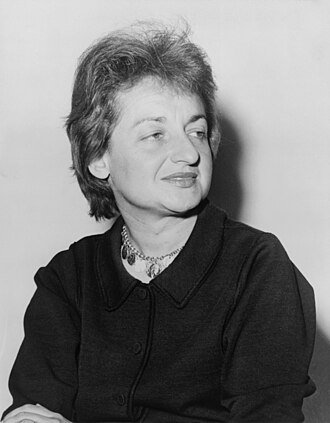
Betty Friedan
1921–2006 · American feminist writer and activist
Betty Friedan (1921-2006) was an American feminist writer and activist, and one of the central figures of the women's movement in the United States. Trained in social psychology, she is widely credited with helping to spark the second wave of American feminism in the twentieth century, and her work remains a common starting point for discussions of gender inequality.
Born Betty Naomi Goldstein in Peoria, Illinois, she grew up in a secular Jewish family whose parents had come from Russia and Hungary. Her father created a necklace business within a jewelry store, and her mother had been editor of a women's page of a local newspaper before leaving her job after marriage. Friedan earned her degree in psychology at Smith College in 1942 and then spent a year of graduate study at the University of California, Berkeley, with the psychoanalyst Erik Erikson. In her memoir she said that pressure from the man she was dating led her to turn down a second fellowship, a decision she later saw as a turning point.
After Berkeley she worked as a journalist for labor and left-leaning publications. She married in 1947 and settled in the suburbs of New York, where she spent much of her time as a housewife while writing freelance articles. In the mid-1950s she surveyed her former college classmates, and the results led her to describe what she called "the problem that has no name", a diffuse unhappiness she believed many middle-class housewives shared. Over several years she interviewed women across the country and concluded that the picture of female fulfilment promoted by advertising, psychology and education was a social construction rather than a natural fact.
Those conclusions appeared in 1963 in The Feminine Mystique, a bestseller that historians often describe as a catalyst for the renewed feminism of the period. Friedan did not present herself as a philosopher, yet her book opened lines of inquiry into personal identity and women's social roles that later became central to feminist thought. Rather than relying on the essentialist arguments of earlier suffragists, she grounded equality in a general human need to grow and develop.
In 1966 she co-founded the National Organization for Women (NOW) and became its first president. The group grew into the leading feminist organization in the country. In 1970 she helped organize a nationwide Women's Strike for Equality, and in 1971 she joined other activists in founding the National Women's Political Caucus. She left NOW's presidency in 1970 after internal conflicts, but continued to back the Equal Rights Amendment and reproductive rights, while criticizing some radical currents within the movement.
In later decades she published books such as The Second Stage (1981), which questioned what she saw as the extremes of some feminist positions, and she remained publicly active into the late 1990s. Her legacy lies in the example she set for collective organizing among women and in her argument that equality is a matter of identity and opportunity for everyone.
Key works
- The Feminine Mystique (1963)
- The Second Stage (1981)
- The Fountain of Age (1993)
- Life So Far (2000)
Where to start
The Feminine Mystique is the natural starting point: it grew out of a survey of former college classmates that exposed the discontent of seemingly content housewives. It is a clear, direct sociological essay, free of academic jargon, that lays out the postwar problem with no name and its cultural causes.
Next: The Second Stage. The Second Stage revisits the debate decades later, examining women's lives after motherhood and work, and rounds out the author's view with her own critical reflection.
Works in Filopedia
- The Feminine Mystique 1963
- The Second Stage 1981
Curiosities
An unpublished article
According to the sources, it was an unpublished article that pushed her to write about the discontent of American women in the 1950s.
A magazine article instead of a sequel
Friedan planned a sequel titled Woman: The Fourth Dimension but ended up publishing only an article with that title in Ladies' Home Journal in 1964.
Teachers and influences
Influenced
- Camille Paglia b. 1947
Original Filopedia text based on Wikipedia (es) and Wikipedia (en) and Wikidata.