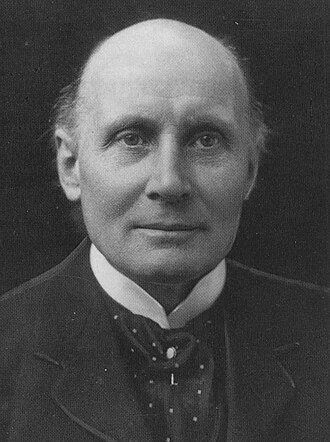
Alfred North Whitehead
1861–1947 · English mathematician and philosopher, founder of process philosophy
Early life and training
Alfred North Whitehead was born in Ramsgate, Kent, in 1861, into a family of educators. His father, also named Alfred, had been headmaster of Chatham House Academy, a school founded by his own father, Thomas Whitehead, and later became an Anglican minister. Whitehead's relationship with his mother, Maria Sarah Buckmaster, was distant: he never mentions her in his writings, and his wife Evelyn held a poor opinion of her.
He was educated at Sherborne, a prominent public school, where he excelled at sport and mathematics and became head prefect of his class. In 1880 he entered Trinity College, Cambridge, to study mathematics under Edward Routh. He took his degree in 1884, with a dissertation on James Clerk Maxwell's Treatise on Electricity and Magnetism, and graduated as fourth wrangler. That same year he was elected a fellow of Trinity, where he taught and wrote on mathematics and physics until 1910. He was also a member of the Cambridge secret society known as the Apostles.
Mathematics at Cambridge
In the 1890s he wrote A Treatise on Universal Algebra (1898), a book for professional mathematicians that studied algebraic structures in themselves rather than only their concrete examples. Whitehead credited William Rowan Hamilton and Augustus De Morgan with originating the subject, and James Joseph Sylvester with coining the term. The book set out to compare Grassmann's theory of extension, Boole's algebra of logic and Hamilton's quaternions, though the planned second volume, which was to treat the quaternions, was never completed.
In 1890 he married Evelyn Wade, an Irish woman raised in France. They had a daughter, Jessie, and two sons, Thomas North and Eric. Eric died in 1918, aged nineteen, while serving in the Royal Air Force during the First World War.
Principia Mathematica and An Introduction to Mathematics
Whitehead's best-known mathematical work is the three-volume Principia Mathematica (1910–1913), written with his former pupil Bertrand Russell. Its aim was to set out a system of axioms and rules of inference in symbolic logic from which all mathematical truths could in principle be derived. The work operated at such a foundational level that the proof that 1+1=2 does not appear until page 86 of the second volume, accompanied by the remark that the proposition was "occasionally useful". The authors had expected the task to take a year; it took ten. The edition, over two thousand pages long and aimed at a very small audience, was published at a loss, which was covered by Cambridge University Press, the Royal Society and the authors themselves.
In 1911 he also published An Introduction to Mathematics, intended for a wider readership. It explained the nature, unity and applicability of mathematics, and in its opening chapter Whitehead made clear that his purpose was not to teach mathematics but to show the student what the science is and why exact thinking is needed in the study of natural phenomena.
From mathematician to philosopher
The legacy of Principia Mathematica is mixed. Kurt Gödel's incompleteness theorem of 1931 showed that no set of axioms could capture all mathematical truths, so the work could not achieve its stated goal. Yet Gödel could not have reached that conclusion without the book, which also popularised modern mathematical logic and built bridges between logic, epistemology and metaphysics.
In the late 1910s his academic responsibilities in London expanded. He was professor of applied mathematics at Imperial College, dean of the Faculty of Science at the University of London, a member of its Senate and chairman of its Academic Council. From these posts he helped secure a history of science department, the Bachelor of Science degree and wider access to the university for students of modest means. Towards the end of his English period his attention turned to philosophy. He published The Concept of Nature in 1920 and served as president of the Aristotelian Society from 1922 to 1923.
Harvard and process philosophy
In 1924, at the age of sixty-three, Henry Osborn Taylor invited him to join Harvard as a professor of philosophy. The Whiteheads remained in the United States for the rest of their lives. In 1925 he published Science and the Modern World, presented as an alternative to the Cartesian dualism that dominated popular science. His Gifford Lectures of 1927–1928 were published in 1929 as Process and Reality, a work often compared in ambition with Kant's Critique of Pure Reason.
Whitehead argued that modern science rested on a conception of matter as irreducible brute stuff made of independent particles, and he held this to be inadequate. For him change is fundamental, things do not remain the same, and what we call a person is a succession of experiential occasions linked in a "society". He called the confusion of a useful abstraction with concrete reality the "fallacy of misplaced concreteness". Likewise he held that relations are primary: an entity is in some sense the sum of its relations and of its response to them. His universe is creative, and every entity, from an electron to a human being, has some degree of novelty and freedom within the limits the world imposes on it.
His work was extremely difficult even for professional philosophers. Shailer Mathews of the University of Chicago admitted that reading his 1926 book Religion in the Making was infuriating. Yet Henry Nelson Wieman, in a 1930 review, predicted that his ideas would spread through successive circles of popularisation until they reached the ordinary person, though only after decades of discussion.
Later years and legacy
Whitehead retired from Harvard in 1937 and remained in Cambridge, Massachusetts, until his death on 30 December 1947. The fullest biography is Victor Lowe's two-volume work. Several aspects of his life remain obscure, since he left no archive: he asked his family to destroy his papers, and his biographer noted an almost fanatical concern for privacy.
Today his thought is applied in fields as varied as ecology, theology, education, physics, biology, economics and psychology. Its most promising application in the twenty-first century lies in ecological civilization and environmental ethics, pioneered by John B. Cobb Jr., who took up his vision of humanity as part of a web of interrelated processes.
Education
Whitehead cared deeply about educational reform. In 1921 Prime Minister David Lloyd George appointed him to a committee of twenty charged with reviewing the British education system. His fullest statement on the subject was The Aims of Education and Other Essays (1929). In it he warned against "inert ideas", scraps of information disconnected from life and culture, and argued that teaching them was not merely useless but harmful. He preferred a few concepts applicable across many areas of life to a broad, scattered curriculum, and held that imagination should illuminate facts rather than stand apart from them.
Key ideas
- Reality as process: what is real consists of processes rather than independent material objects.
- Relations before parts: each process is defined by its relations with other processes, not as an isolated piece of matter.
- A web of interdependence: we are part of a network of processes, and our decisions affect the world around us.
- Extensive abstraction: the basis of mereotopology, which studies relations among wholes, parts and boundaries.
Works in Filopedia
- Process and Reality 1929
Books to read
- Principia mathematica, vol. 1 (of 3) EnglishGutenberg
- Science and the modern world EnglishGutenberg
- The Concept of Nature The Tarner Lectures Delivered in Trinity College, November 1919 EnglishGutenberg
- An Introduction to Mathematics EnglishGutenberg
- Principia mathematica, vol. 2 (of 3) EnglishGutenberg
- An enquiry concerning the principles of natural knowledge EnglishGutenberg
- Symbolism, its meaning and effect : Barbour-Page lectures, University of Virginia, 1927 EnglishGutenberg
Curiosities
A difficult book among the best
Principia Mathematica placed 23rd on the Modern Library's list of the top 100 English-language nonfiction books of the twentieth century.
A fiercely private life
Whitehead was known for an almost fanatical belief in privacy, and Victor Lowe remarked that no professional biographer in his right mind could have attempted his life.
Teachers and influences
Influenced
- Bertrand Russell 1872–1970
- Gilles Deleuze 1925–1995
- Haskell Curry 1900–1982
- David Ray Griffin 1939–2022
- C. D. Broad 1887–1971
- John B. Cobb 1925–2024
- Heinrich Scholz 1884–1956
Original Filopedia text based on Wikipedia (es) and Wikipedia (en) and Wikidata.