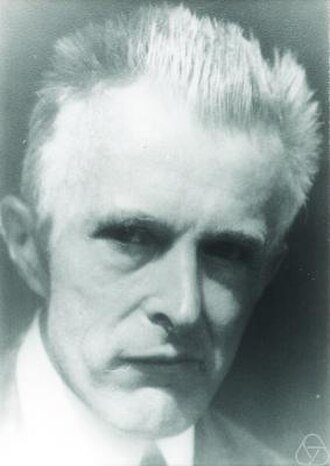
Heinrich Scholz
1884–1956 · German logician, philosopher and Protestant theologian
Heinrich Scholz (Berlin, 1884 – Kiel, 1956) was a German logician, philosopher and Protestant theologian. He is best known for shaping mathematical logic in Germany in the first half of the twentieth century and for founding a research institute that kept that tradition alive after the Second World War.
He studied philosophy and theology at Erlangen and Berlin, training under Adolf von Harnack and Alois Riehl. His early work centred on the philosophy of religion, but around 1921 he encountered Russell and Whitehead's Principia Mathematica and turned decisively towards logic. He held chairs at Breslau and Kiel before moving to Münster in 1928, where he founded the Institute of Mathematical Logic and Fundamental Research in 1936. The so-called Münster school grew around it.
Scholz regarded mathematical logic as the foundation of knowledge and held a broadly Platonist view of mathematics. His lasting contribution lay in building an environment where his students could work at the highest level, and he played a key role in rescuing and editing the papers of Gottlob Frege. He maintained contact with Alan Turing in the 1930s, and the seminar he ran at Münster is often cited as one of the earliest in computer science.
Key ideas
- Logic as foundation: for Scholz, mathematical logic was the basis on which rigorous knowledge rests.
- Mathematical Platonism: he treated mathematical objects as realities independent of the mind, which the researcher discovers.
- Recovery of Frege: he promoted the study and editing of Frege's work and championed his legacy.
- Theology and logic: his theological training nurtured a search for conceptual rigour that he later applied to logic.
Curiosities
From theology to logic
Scholz trained first as a theologian and did not turn to logic until well into his academic career.
A letter about Turing
In 1937 Turing wrote a letter commenting on the reception of his paper on computable numbers, and Scholz was one of his correspondents in Germany.
Teachers and influences
Teachers
- Alois Riehl 1844–1924
Influenced by
- Alfred North Whitehead 1861–1947
Original Filopedia text based on Wikipedia (en) and Wikidata.