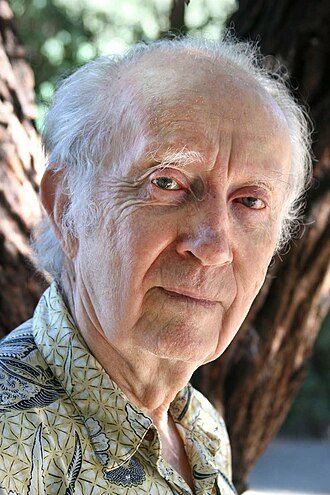
John B. Cobb
1925–2024 · American theologian, philosopher and environmentalist, leading figure of process theology
John B. Cobb Jr. (1925-2024) was an American theologian, philosopher and environmentalist, regarded as the foremost scholar of process theology, the school of thought linked to Alfred North Whitehead. Across more than fifty books, he sought to connect theology with ecology, economics and other fields rather than keep them apart.
Born in Kobe, Japan, in 1925, to Methodist missionary parents, he spent his early years in Kobe and Hiroshima before moving to Georgia in the United States as a teenager. The racism he saw there, and the way the same events were framed differently from one country to another, pushed him toward a critical stance on the views of his time. After serving in the army during the occupation of Japan, he studied at the University of Chicago, where Whitehead's ideas, taught by Richard McKeon, Daniel Day Williams and Charles Hartshorne, helped him rebuild his faith. In 1958 he settled in Claremont, California, where he taught for decades and founded the journal Process Studies and the Center for Process Studies.
Cobb held that nature is not a purposeless machine and that reality is better understood as a flow of events than as fixed substances. From the late 1960s, ecological interdependence became the core of his work, and his critique of growth-based economics led him, with his son, to devise an alternative to gross domestic product.
His influence reaches theology, ecology and economic ethics, and the movement he helped build remains active in academic centres around the world.
Key ideas
- Ecological interdependence: every part of an ecosystem depends on the others, and humanity's most urgent task is to preserve the world it relies on.
- World-loyalty: Whitehead's phrase for the human duty of care toward the natural world.
- Process thought: reality consists of events in constant change rather than of unchanging substances.
- Constructive postmodernism: an attempt to build a comprehensive view of the world, without giving up metaphysics as deconstructionists had done.
- Critique of growth economics: gross domestic product does not measure real well-being, so he proposed indicators that include ecological and social factors.
Curiosities
Childhood in Japan
He was born in Kobe to Methodist missionary parents and received much of his early schooling at the multi-ethnic Canadian Academy in Kobe.
A faith put to the test
In Chicago he deliberately exposed his faith to modern objections; by his own account it collapsed within six months, before he rebuilt it with the help of Whitehead's philosophy.
Teachers and influences
Influenced by
- Alfred North Whitehead 1861–1947
Original Filopedia text based on Wikipedia (es) and Wikipedia (en) and Wikidata.